John Crowley Has Died

John Crowley, certainly one of my top ten favorite authors, has died. He was not a best-selling writer, though pretty well known among science fiction and fantasy fans. His most celebrated novels are “Little, Big,” and the four book “Aegypt” series. He also wrote film documentaries and taught creative writing at Yale. Of him the great critic, Harold Bloom said: “Crowley writes so magnificently that only a handful of living writers in English can equal him as a stylist, and most of them are poets…of novelists, only Philip Roth consistently writes on Crowley’s level.”

https://en.wikipedia.org/wiki/John_Crowley_(author)

Although my writing style is nothing like his (If only!), Crowley’s work has had a profound effect on my the way I approach writing a novel. The circumstances of my discovery of Crowley are almost as strange and uncanny as something from one of his stories.

In 1983 my my little family moved to Skagway Alaska, where I began building a log house. (See those images and comments elsewhere on this website.) My wife worked as a bartender and waitress, and I worked part time as a sort of carpenter/handyman. One day, while cleaning out a rental house I was doing some maintenance on, I found a box of cast away clothing, kitchen odds and ends, and paperback books left behind by one of the seasonal workers who came to Skagway every year to work in the tourist industry.

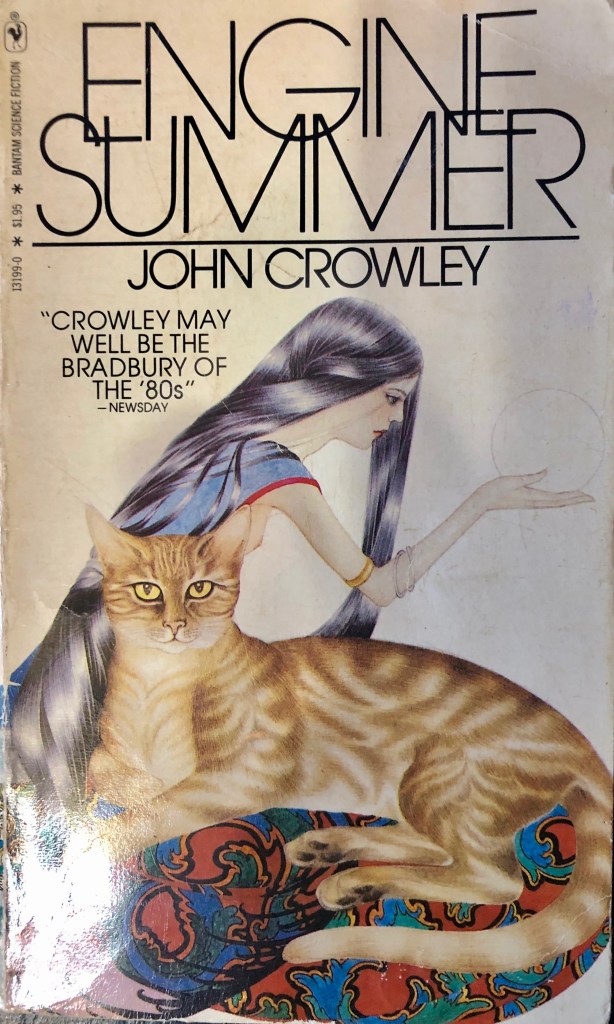
Normally I choose the books I want to read very deliberately, usually after reading reviews or getting suggestions from people with similar tastes in literature. I can’t recall ever before or since discovering a favorite author or book by chance alone. But something about the cover image and the intriguing title of “Engine Summer” made me pause and separate it from the rest of the things in that cardboard box. The name of the author also appealed to me. I had recently read two books by Aleister Crowley, and wondered if this John Crowley might be a relative. (In one of his blogs John Crowley assured his readers was not related, as far as he knew, and that Crowley is a fairly common English surname.)

I opened the book and read the writing on the inside of the cover. Immediately I wondered if this was a quote from the book, and if not, why was it there and who could have written it? (As you can see the name was scribbled out, as if the writer thought better of revealing his identity — see image below). I was hooked and began reading that same evening. Since then I have read the little novel dozens of times over the years. The book has some sort of strange hold on me, and each time I read it I discover something new. It is a melancholy tale, and profound on many levels.
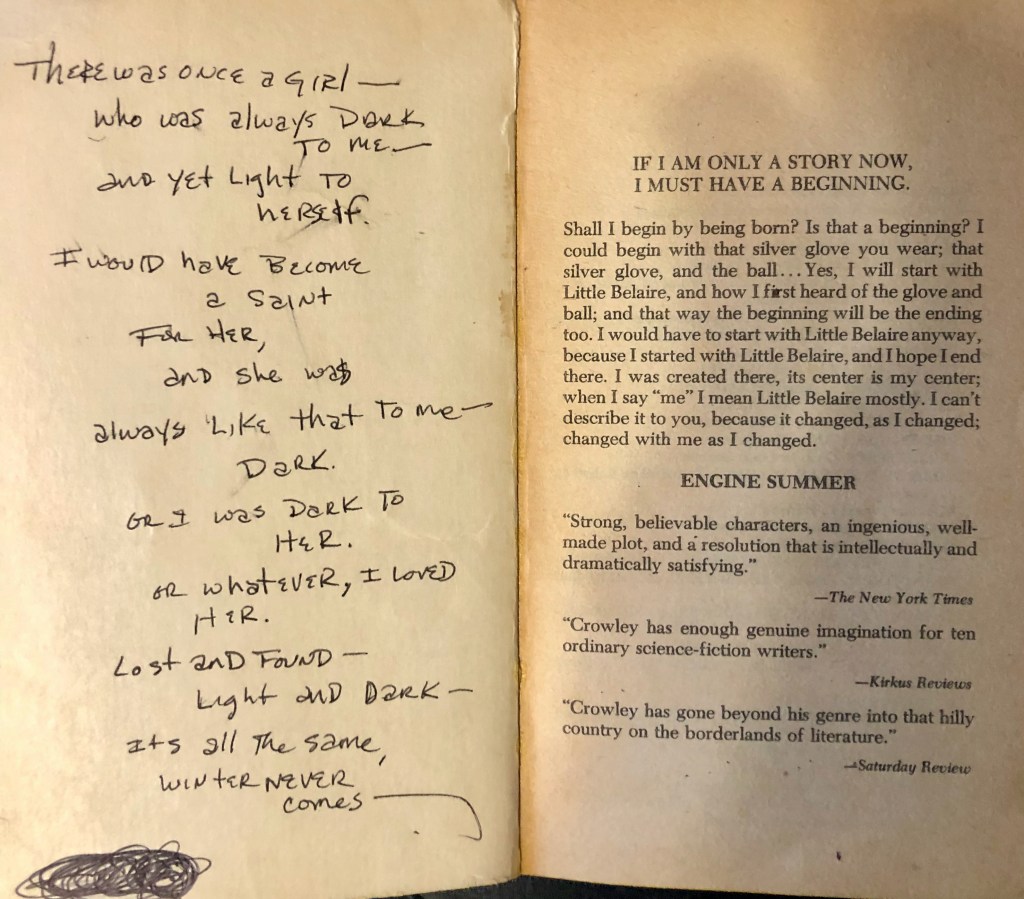
Since that summer of 1983 I’ve bought and given away many copies of Engine Summer, (including copies to all the actors and musicians in my musical, “Evermore”), but I’ve kept my treasured original Bantam 1980 edition. I’ve never found out who left that book behind, or wrote the words on the inside of the cover. I’ve also gone on to read most of Crowley’s other works. My favorites by him are “The Deep,” “Little, Big,” the “Aegypt” series, and several of his short stories.

In 2012 I got the idea of creating a musical based on Engine Summer. I extracted the basic love story, and my musical partner, Jim Nelson and I wrote songs for the play, which I entitled, “Evermore.” In 2013 the play was produced on two stages in Mt. Vernon and Bellingham, WA. (Images and commentary about Evermore are also elsewhere on this website.) I sent a link to a video of one of the performances to John Crowley. He remarked that he really enjoyed the music, but refrained from commenting on my bowdlerization of his novel.

Beyond the obvious inspiration for my play, Crowley has influenced me in other ways. He referred to “snakes-hands”— the parts of stories that don’t obviously advance the plot or character development—as some of the best parts of a tale. I agree, and to hell with critics or editors that say every word and sentence must serve the plot. I always include “snakes-hands” in my novels.

It is evident to me that Crowley knew the value of the role of the subconscious in good writing, and he admitted that some things in his novels seemed uncanny. I know what he is talking about. There are times when an idea will come to me seemingly “out of the blue,” or a character will simply not obey my desires. Sometimes, after days or weeks of no progress, I will wake knowing just exactly how a plot puzzle should be resolved. I never thought this way before reading Crowley’s works, particularly “Engine Summer,” “The Deep,” and “Little, Big.”

Certainly John Crowley was one of the great masters of the novel form, and deserves a much wider readership. But enough talk. If like me you love great writing, get a copy of one of Crowley’s novels or short story collections from your local bookstore or library. John Crowley has passed on, but fortunately for us most of his books are still in print and here for us to enjoy and marvel at. To paraphrase John from “Little, Big,” his fictional world gets bigger the further in you go.

“The world is older than it was. Even the weather isn’t as we remember it clearly once being; never lately does there come a summer day such as we remember, never clouds as white as that, never grass as odorous or shade as deep and full of promise as we remember they can be, as once upon a time they were.” (from Little, Big)
Deadheads In The High Desert

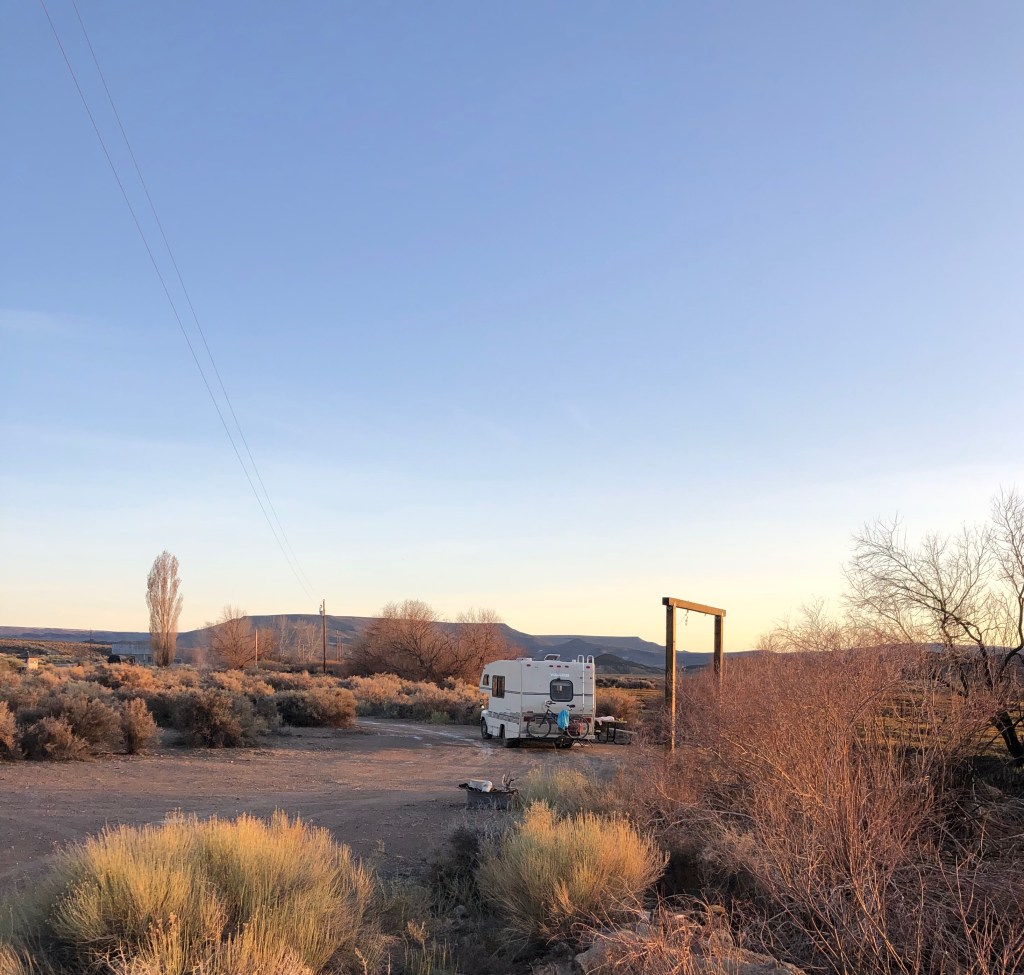
“Kermit” parked at a campsite in the Nevada outback.

While I was working towards my B.A. in Anthropology at the University of Oregon I had many opportunities to see the Grateful Dead. They played often in the area. The first Dead concert I attended was in 1968, when I was a high school senior. Although I never considered myself a “Deadhead,” their record albums were on regular rotation at the places I lived while in college, along with Miles Davis, John McLaughlin, Larry Coryell, Pink Floyd, and other popular rock and jazz bands of the era. I lived with musicians most of my years at the university, and our record collection was certainly more diverse and eclectic than most of our peers. I’ve never been in any bands that played their music, but I have always admired the Grateful Dead’s commitment and musical integrity.

When I travel the high deserts and Great Basin region I often encounter other campers and travelers who attended the U of O, or live in Eugene. I suppose the progressive, liberal culture of the university and Eugene has had a great effect on how I view the world, for I always feel an immediate connection to those people.

The recent death of Bob Weir reminds me of an encounter I had the summer of 2023 at a remote and undeveloped hot springs in Nevada. I drove up a long, dusty dirt road to the unmarked place. An old Volkswagen bus was the only other vehicle present. Dozens of Grateful Dead of stickers covered the entire back of the machine.

There were only two people in the hot springs, a couple my age or older. As manners and custom dictated I asked if I could join them, and they replied that there was plenty of room and I was welcome. The water was waist high, and the temperature perfect.

In the course of a rambling conversation about favorite hot springs and camping locations, Nevada history (my mother grew up in Nevada), music, and the sorry state of American politics, the man revealed that he had attended the U of O two of the same years I had been there. He told me he had gone to one of the Grateful Dead concerts, dropped out of college the next day, packed up his things, and began following the band. Eventually he got a job as a stage hand and sort of assistant bodyguard (he was a big man). He toured with the Dead for ten years, and he and his wife met at a Grateful Dead concert. Nearly fifty years later he was still married to the white-haired woman sitting next to him in the hot springs.

They went on to tell me their van used to be plastered with a variety of bumper stickers, mostly for progressive causes—women’s reproductive rights, anti-war, etc. But while traveling through some towns and rural areas MAGA cultists and other right-wingers, usually driving big Dodge Ram pickups or flatbed trucks would honk, flip them off, or even crowd them off the road. So they removed all the stickers except the Grateful Dead ones. After that they got smiles and high fives everywhere they went. It seems even the rednecks loved the Dead!

We were just three strangers meeting by chance in the middle of nowhere, lured by a mutual love of hot springs, and remote high desert camping, and finding an even deeper connection—another testament to the power of music to unite us. Long live the Dead!

My Article in May/June Latitudes & Attitudes

A Long Day On The Inside Passage
Feature article May/June Latitudes & Attitudes

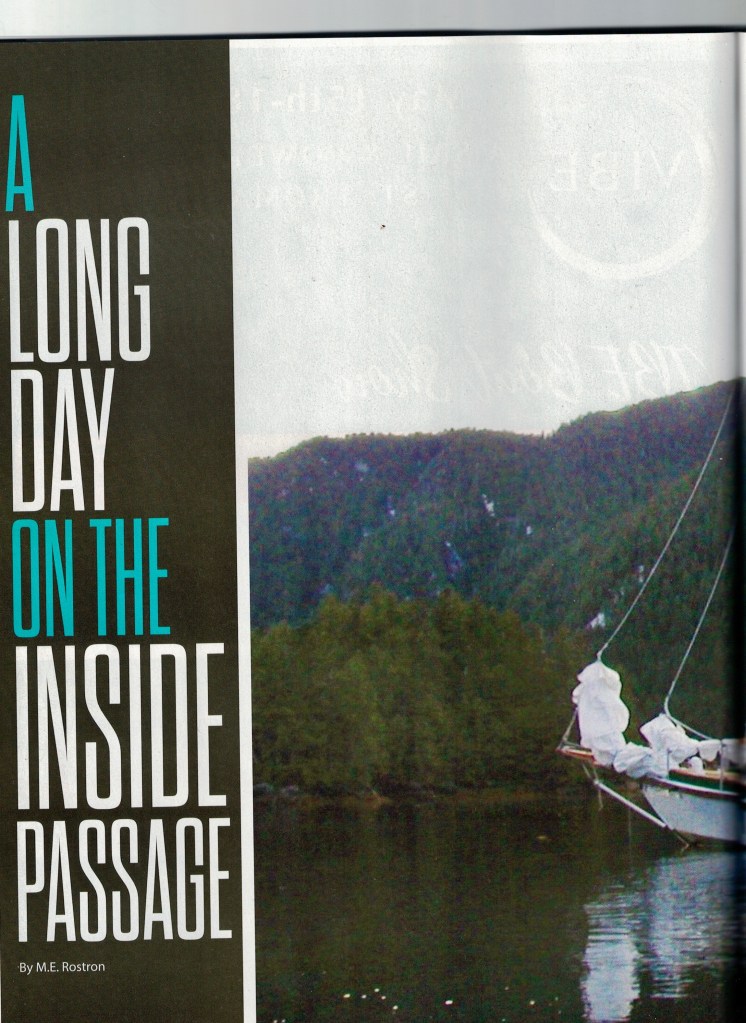
My article, “A Long Day On The Inside Passage” has been published on page 82 in the May/June addition of Latitudes & Attitudes magazine, which is now out on the newsstands. The publication did a nice job with the layout, using photos I sent along with the article. They also included links to this website and my latest novel. These sorts of features don’t pay much, but the publicity is always welcome. Those who have read my 2019 novel, “Cape Decision” will recognize the inspiration for one of the incidents in that book. Latitudes & Attitudes is in its 27th year of publication, and the most popular print magazine for sailors, cruisers, and boaters. Their print version comes out six times a year. They also produce an online version.

You can read part of the article without a subscription here. https://latsatts.com/a-long-day-on-the-inside-passage/

73 Is Not The New 43! Lessons From My Great-grandfather

After the age of seventy death walks closely behind, scythe at the ready. Only a fool thinks otherwise. Everybody I know over about sixty-five has some sort of chronic health issue. We suffer from various aches and pains that seem to wax and wane with the weather, and most have hypertension, and soreness and stiffness from old injuries. Most conversations with people our age eventually devolve into “organ recitals” — a litany of our infirmities, impairments, surgical procedures, and pharmacopeia.

The actuarial tables don’t lie, and very few over the age of seventy are physically or mentally up to new challenges. Although more of us live longer, we’re not necessarily living healthier. Many are overweight, and most out of shape. Medical science keeps us out of the morgues a little longer, but human biology has not changed. The most reliable way to predict your life span, assuming you don’t slip on a banana peel and break your skull, or get in a car wreck, is to see how long your ancestors lived — a good reason to do some genealogy. 

It’s time to write my memoirs or autobiography if I’m going to do it. Why do that if you’re not famous? Not many readers are interested in the lives of the not-famous or infamous. But I think there are several good reasons, besides hubris, to leave a first person written account of your life, even if you don’t publish it. Aside from the value to future historians who may be researching our era, a firsthand record of your life is perhaps the most valuable thing you can leave your descendants, unless you are wealthy — then leave money and property! 

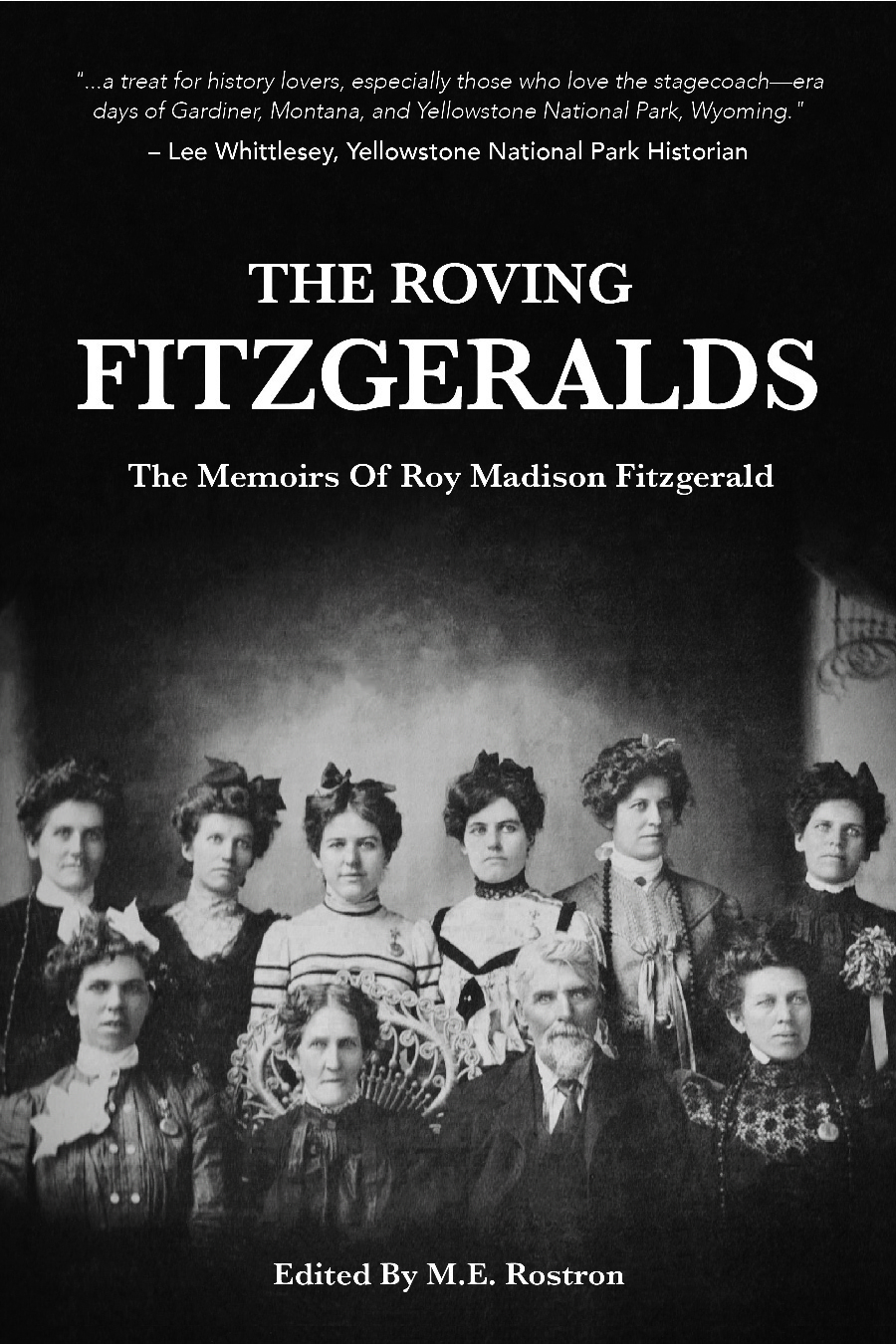
Rediscovering my great grandfather’s long lost writings was a remarkable event, and the year long editing and researching prior to publishing the book was fascinating. (“The Roving Fitzgeralds,” 2021.) The months I spent preparing the book for publication led me down many paths, intellectually and emotionally. I connected with my family history in ways I hadn’t before. I experienced a sense of what it was like to live in the era before all the mechanical and electronic gadgets we take for granted existed.

I wish more of my ancestors had written about their lives. It would be wonderful to have Selleck or Mary Fitzgeralds’s first hand notes on their wagon train trip from Iowa to California in 1862, and their subsequent travels by horse and wagon to Oregon and Montana. I wish Selleck’s grandparents would have left a first hand record, even a diary or journal, of their immigration from Ireland to Virginia in the 1740s. Alas, I know of no written records other than Roy Fitzgerald’s from either side of my family.

I’ve never been a fan of the sort of confessional or tell-all memoirs that often make the bestseller’s lists. I’m not very interested in Einstein’s sexuality or relations with women, but I am fascinated with his intellectual development, his breakthroughs in physics, his interactions with other scientists, politicians, and his ties to the Manhattan Project.

If I decide to write an autobiography or memoir, I’ll approach the project much as my grandfather, Roy Fitzgerald did. His intention was to relate the most notable incidents in his life, and to give the reader a sense of what it was like to be alive during those years, while imparting interesting information about the history of Yellowstone Park, Montana, Nevada, and Oregon, during an era when the the automobile was replacing the horse, and the phone, rails, and roads were connecting the West to the rest of the world. Considering that Roy dropped out of school after the eighth grade, he did a nice job of it. I would be happy to do as well.

Roy’s memoirs almost didn’t get written. He began writing when he was in his early eighties, and died at the age of eighty-seven. It was a near thing, as his health was failing, but he still managed to make several trips from Oregon to Montana to verify his memories of some of the events he recalled from his youth in Gardiner. He barely lived to finish his memoir, and did not live to see it published. 

I don’t want to make that same mistake, and it’s certainly not given that I will be mentally or physically capable of writing my memoirs or autobiography in the future. So I’d best be about it, and so should you if you’re over sixty-five, because seventy-three will never be the new forty-three!

Another Much Sadder Birthday

My birthday this year coincided with most of the results of the midterms coming in. The outcome is better than I had hoped, giving me some cause for optimism. Although I have much to be grateful for this year, my youngest daughter’s absence made the occasion bittersweet. Any joy I feel is tempered with sadness now. In my last blog I was brimming with energy and confidence, excited about publishing my third book and looking forward to an author event March 24 at Village Books in Bellingham. My daughter, Haley, died that very morning of a fentanyl overdose. My wife and I spent the day at the hospital, where they managed to get her heart beating, but she did not regain consciousness.

I look back on my post from last year, “Thoughts On Becoming 70,” and I don’t know whether to laugh or cry. Such hubris. The wise old man—ha! Spry old guy with all his plans and projects—ha-ha! Grief can lay us low, I know. I had an urge to delete that post after reading it again, but I’ll leave it up, as an example of how the universe will give us a reality check.

But life goes on for the living, and the question is always how best to spend our time, and how to find some meaning in our remaining days. Some of us are fortunate. Many millions must use every available hour just to provide for their necessities. Though not by any means well-off by “Western” standards, I have the luxury of not having to scramble every waking hour to survive—and, for the moment, time and health to pursue my writing and musical projects. What else can I do? Those who know me understand I am compelled to such activity. The only way I know how to deal with grief is to stay busy. So I trudge on, sadder and perhaps no wiser, but certainly more appreciative of my family and friends, and far more empathetic with those parents who have outlived their children—the most desolate and heartbreaking grief of all.

One bright spot was the return to performing this summer in Lemon Creek. The time I spend rehearsing and performing with my daughter, Lesley, is more precious than ever. All our performances were out of doors, and the weather cooperated. I put up a few photos at the Lemon Creek page here.

I had to take a break from writing for a few months, but I’m back at it again. I’m working on a sequel to “Cape Decision,” and I’ve got a couple of other books in progress. But I don’t take anything for granted. We’ll see what transpires.