John Crowley Has Died

John Crowley, certainly one of my top ten favorite authors, has died. He was not a best-selling writer, though pretty well known among science fiction and fantasy fans. His most celebrated novels are “Little, Big,” and the four book “Aegypt” series. He also wrote film documentaries and taught creative writing at Yale. Of him the great critic, Harold Bloom said: “Crowley writes so magnificently that only a handful of living writers in English can equal him as a stylist, and most of them are poets…of novelists, only Philip Roth consistently writes on Crowley’s level.”

https://en.wikipedia.org/wiki/John_Crowley_(author)

Although my writing style is nothing like his (If only!), Crowley’s work has had a profound effect on my the way I approach writing a novel. The circumstances of my discovery of Crowley are almost as strange and uncanny as something from one of his stories.

In 1983 my my little family moved to Skagway Alaska, where I began building a log house. (See those images and comments elsewhere on this website.) My wife worked as a bartender and waitress, and I worked part time as a sort of carpenter/handyman. One day, while cleaning out a rental house I was doing some maintenance on, I found a box of cast away clothing, kitchen odds and ends, and paperback books left behind by one of the seasonal workers who came to Skagway every year to work in the tourist industry.

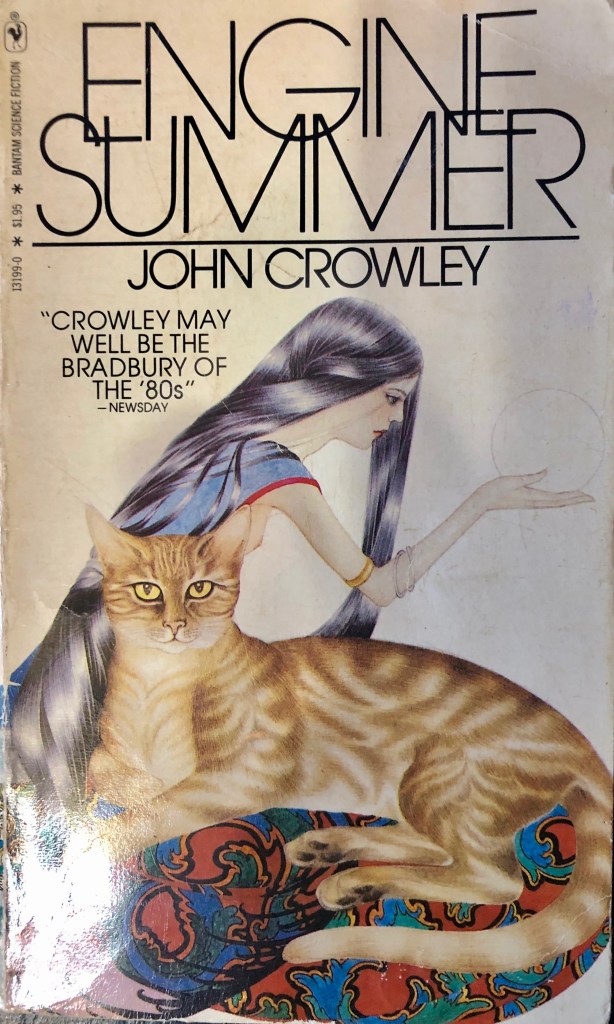
Normally I choose the books I want to read very deliberately, usually after reading reviews or getting suggestions from people with similar tastes in literature. I can’t recall ever before or since discovering a favorite author or book by chance alone. But something about the cover image and the intriguing title of “Engine Summer” made me pause and separate it from the rest of the things in that cardboard box. The name of the author also appealed to me. I had recently read two books by Aleister Crowley, and wondered if this John Crowley might be a relative. (In one of his blogs John Crowley assured his readers was not related, as far as he knew, and that Crowley is a fairly common English surname.)

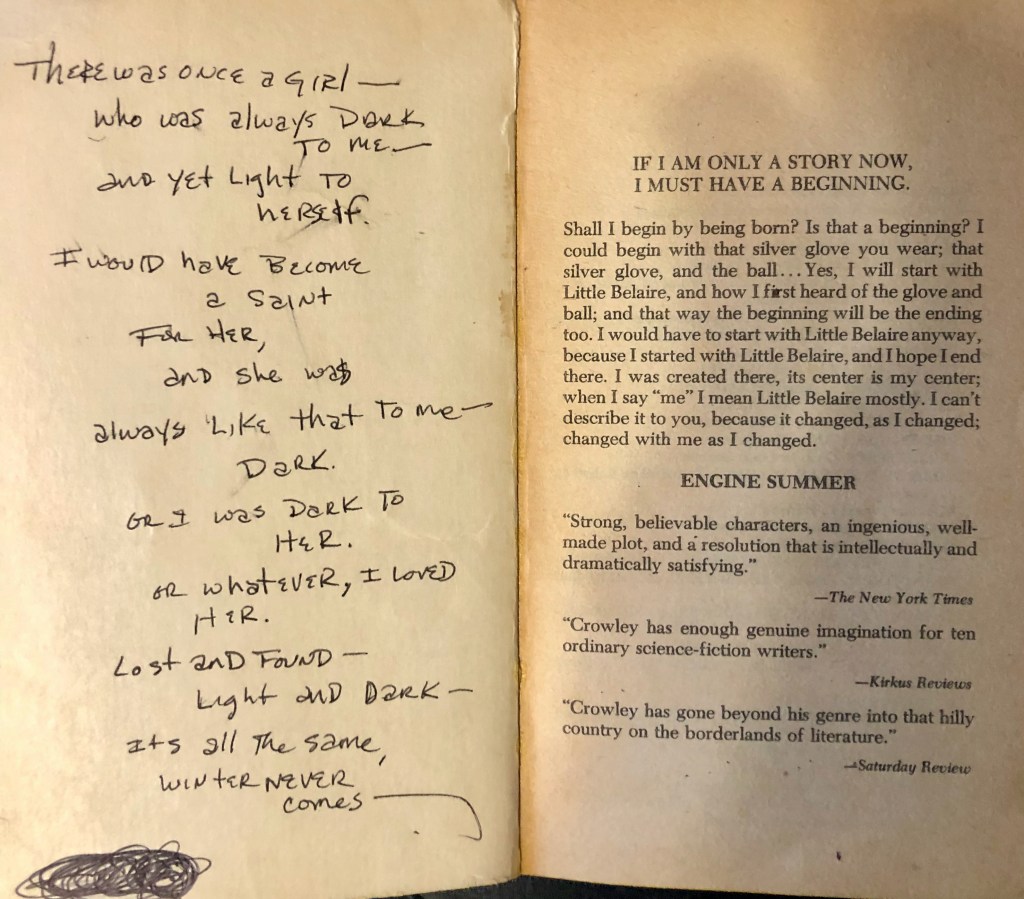
I opened the book and read the writing on the inside of the cover. Immediately I wondered if this was a quote from the book, and if not, why was it there and who could have written it? (As you can see the name was scribbled out, as if the writer thought better of revealing his identity — see image below). I was hooked and began reading that same evening. Since then I have read the little novel dozens of times over the years. The book has some sort of strange hold on me, and each time I read it I discover something new. It is a melancholy tale, and profound on many levels.
Since that summer of 1983 I’ve bought and given away many copies of Engine Summer, (including copies to all the actors and musicians in my musical, “Evermore”), but I’ve kept my treasured original Bantam 1980 edition. I’ve never found out who left that book behind, or wrote the words on the inside of the cover. I’ve also gone on to read most of Crowley’s other works. My favorites by him are “The Deep,” “Little, Big,” the “Aegypt” series, and several of his short stories.

In 2012 I got the idea of creating a musical based on Engine Summer. I extracted the basic love story, and my musical partner, Jim Nelson and I wrote songs for the play, which I entitled, “Evermore.” In 2013 the play was produced on two stages in Mt. Vernon and Bellingham, WA. (Images and commentary about Evermore are also elsewhere on this website.) I sent a link to a video of one of the performances to John Crowley. He remarked that he really enjoyed the music, but refrained from commenting on my bowdlerization of his novel.

Beyond the obvious inspiration for my play, Crowley has influenced me in other ways. He referred to “snakes-hands”— the parts of stories that don’t obviously advance the plot or character development—as some of the best parts of a tale. I agree, and to hell with critics or editors that say every word and sentence must serve the plot. I always include “snakes-hands” in my novels.

It is evident to me that Crowley knew the value of the role of the subconscious in good writing, and he admitted that some things in his novels seemed uncanny. I know what he is talking about. There are times when an idea will come to me seemingly “out of the blue,” or a character will simply not obey my desires. Sometimes, after days or weeks of no progress, I will wake knowing just exactly how a plot puzzle should be resolved. I never thought this way before reading Crowley’s works, particularly “Engine Summer,” “The Deep,” and “Little, Big.”

Certainly John Crowley was one of the great masters of the novel form, and deserves a much wider readership. But enough talk. If like me you love great writing, get a copy of one of Crowley’s novels or short story collections from your local bookstore or library. John Crowley has passed on, but fortunately for us most of his books are still in print and here for us to enjoy and marvel at. To paraphrase John from “Little, Big,” his fictional world gets bigger the further in you go.

“The world is older than it was. Even the weather isn’t as we remember it clearly once being; never lately does there come a summer day such as we remember, never clouds as white as that, never grass as odorous or shade as deep and full of promise as we remember they can be, as once upon a time they were.” (from Little, Big)
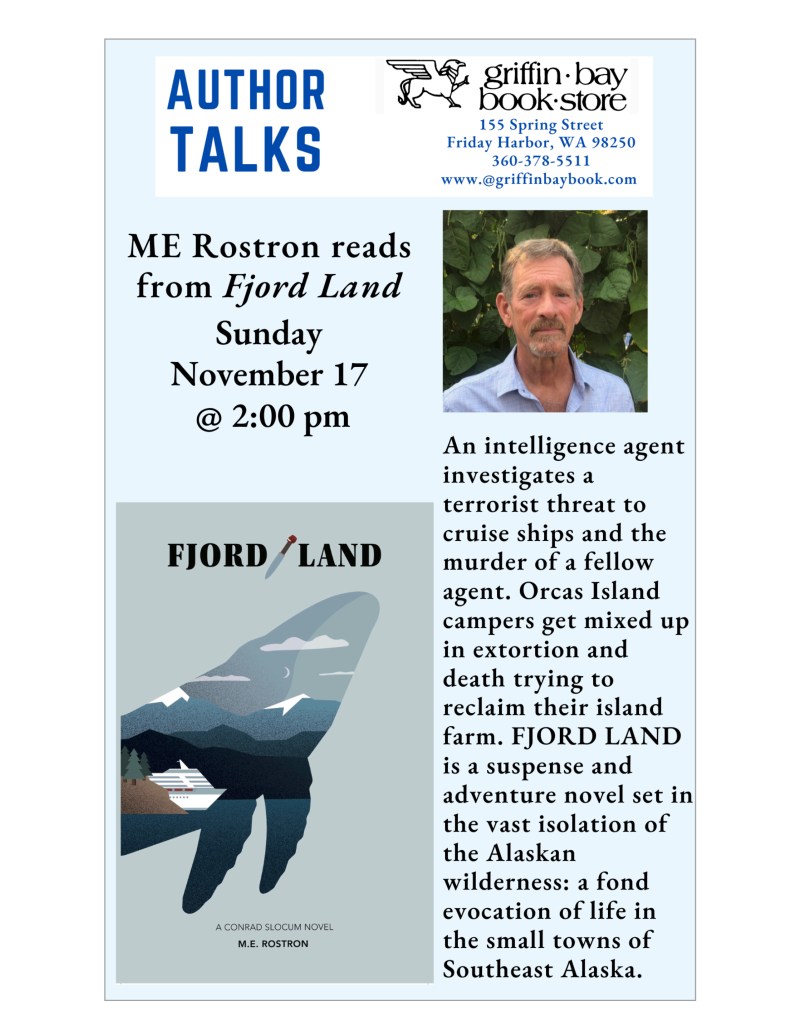
Friday Harbor, November 17

I’m looking forward to my third author event this fall. I like taking the ferry out to the San Juan Islands. This summer I was lucky enough to perform twice with Lemon Creek in the San Juans, but this time it will be a solo act, and certainly not as entertaining, or as danceable! I was also fortunate to have five actors read passages from Fjord Land and Cape Decision at my last author event in Bellingham, but I won’t be able to bring them to Friday Harbor. Although I will focus on my latest novel, Fjord Land, I’ll talk some about my other books too, and take questions about any of the books, my approach to writing, or related subjects.

If you have a favorite Northwest bookstore you think I should hold an author event in, tell the event manager or owner to contact me here, and I will be happy to follow up.

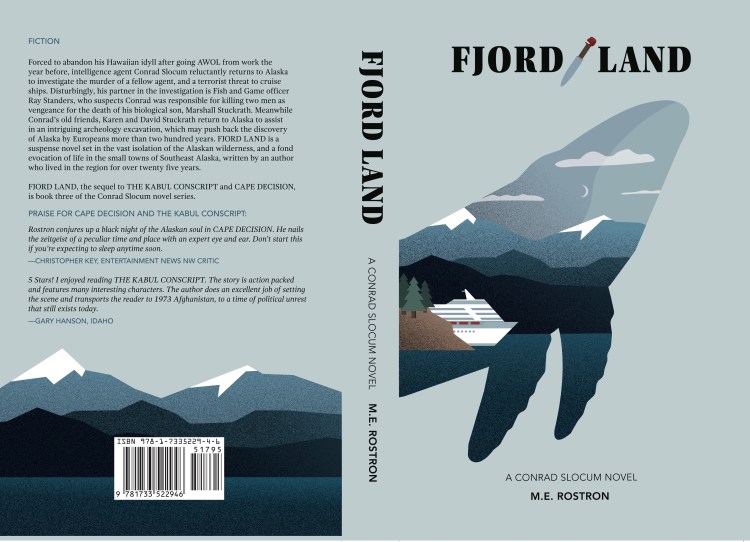
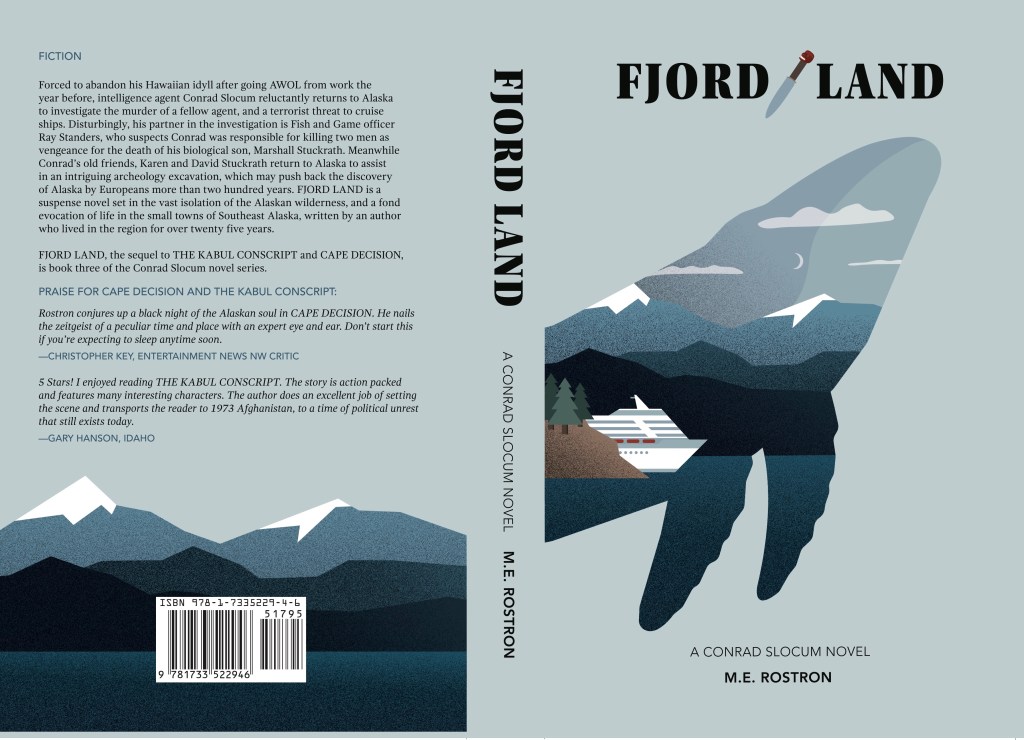
Cape Decision Sequel, “Fjord Land” Coming Soon—An Excerpt Here. Another Great Cover By Kenzie Mahoskey!

I have a teaser for you, the fans of my two novels, The Kabul Conscript and Cape Decision.

Some readers have asked if I planned to publish another Conrad Slocum novel. I had hoped to write at least two more sequels before The Roving Fitzgeralds occupied me for most of 2021.

Since the Fitzgerald memoirs were published several writing projects have competed for my time and attention. I wrote a children’s book, which I hope to publish someday soon. Then came the science fiction short story, An Actuarial Tale which was published by the HamLit literary journal recently. At the same time more ideas continued to bubble away in that space between the unconscious and conscious where my story concepts seem to originate. One was the plot for a Cape Decision sequel.

I can now confirm that Fjord Land is in the pipeline and will be published sometime this May or June(2024)!

Although Cape Decision can be read without first reading the prequel, The Kabul Conscript, that isn’t the case with Fjord Land. For background you’ll want to read the first two in the series. The new story is set a year after Cape Decision, in 2002. Most of it takes place in Southeast Alaska. The novel features some of the same characters, and introduces more.

Pick up your copies of Cape Decision and The Kabul Conscript, and any other books from your local bookstore. Your local, independent bookstore can order these if they’re not in stock, and your money will circulate in your community.

Here’s an excerpt from the opening chapter. I hope it whets your appetite!

Skagway, Alaska

On a pleasant morning in early August, 2002 the immense cruise ship, Opal Princess disgorged a steady stream of passengers onto the Skagway dock. The ship, nine hundred fifty feet long, with a beam of over one hundred feet, and housing over four thousand passengers and crew—more than twice the swollen summer population of the tourist town itself—was visible from anywhere in town. It towered over the the well preserved gold rush community, whose tallest building, the Golden North Hotel, was a quarter the height of the vessel’s two hundred foot tall gleaming white superstructure.

Some summer days during the four month tourist season, Skagway, located at the far northern end of Southeast Alaska’s northern most fjord, entertained as many as four of the “Love Boats.” Two of the massive vessels could just barely fit end to end at the dock that ran along the steep cliffs on the southeast side of town. One or two more could be shoehorned into the small harbor at the White Pass Railroad pier in front of the town, further to the west.

Sandwiched between the giant floating cities, adding yet more traffic in bodies and automobiles to the mix, were the Alaska Marine Highway facilities; the ferry system that connected the major communities of Southeast Alaska. Although there was plenty of depth to accommodate the thirty foot draft of the largest vessels, the huge tidal fluctuations—fifteen feet and more, presented some challenges to berthing the massive ships. Additionally, the brisk winds that often funneled down Lynn Canal, the long narrow fjord that terminated at Skagway, sometimes prevented the ships from docking. On those occasions they were forced to turn back and substitute a stop at Haines, some fifteen miles further south, or retreat all the way back to Juneau, to the disappointment of both the passengers and the owners of the dozens of gift shops lining Skagway’s main thoroughfare, Broadway Street.

On this day the winds were calm, and the captain and crew, aided by the local tugboat had experi- enced no difficulties in maneuvering or docking. Most of the passengers were headed to the train station to board for the scenic trip up the famed White Pass, one of the two mountain passes leading to the Yukon and the historic gold rush towns in the Canadian interior. Other tourists continued on to the picturesque restored downtown, to run the gauntlet of the gift shops lining the wooden boardwalks of the eight block long business district.

The Jenkins family; Jim and his wife, Denise; Jim’s sister, Tess; and their children; eight year old Jimmy Jr., and twelve year old Samantha, had previously purchased a tour package which included the train trip, and an afternoon helicopter excursion to the glacier fields in the mountains above Skagway. It was their first trip to Alaska, and first on a cruise ship. All, especially Jimmy Jr., were excited to explore the town.

“Let’s stay together now, Jimmy!” his father called as the exuberant boy ran ahead along the dock, threading his way through the other disembarking passengers.

“Ah dad—you guys are too slow! I want to see those pictures on the rocks,” he called, pointing at the spray painted words and images that decorated (or de- faced, some said) the sheer cliffs above the dock.

“Maybe we can on the way back. We don’t have time for that now—come on back now, Jimmy!” his mother insisted.

But the boy had been cooped up for too long on the tour ship, and continued on, ignoring the entreaties of his parents.

“Samantha—go get your brother and bring him back here! We’ve only got thirty minutes until the train leaves.” her aunt Tess ordered.

It was her opinion that her younger brother and his wife were much too lenient with their son.

The girl, more obedient than her unruly brother, darted off after the boy. She caught him just as he was attempting to climb over the dock railing.

“What are you doing, Jimmy? Why do you always have to cause trouble?”

“Ah dad—you guys are too slow! I just want to see those pictures on the rocks,” he called, pointing at the spray painted words and images that decorated (or defaced, some said) the sheer cliffs above the dock.

“Maybe we can on the way back. We don’t have time for that now—come on back, Jimmy!” his mother insisted.

But the boy had been cooped up for too long on the tour ship, and continued on, ignoring the commands of his parents.

“Samantha—go get your brother and bring him back here! We’ve only got thirty minutes until the train leaves!” her aunt Tess ordered. It was her opinion that her younger brother and his wife were much too lenient with their son.

The girl, more obedient than her unruly brother, darted off after the boy. She caught him just as he was attempting to climb over the dock railing.

“What are you doing, Jimmy? Why do you always have to cause trouble?”

“There’s something down there—I saw it, Sam! Let go of me!”

“You can’t go down there. The sign says keep off. Anyway, you’ll probably fall in and they’ll have to get the fire department and police to rescue you.”

Still, Samantha was intrigued.

“Look yourself,” her brother said, pointing to one of the gaps between the thick planks of the dock.

His sister got down on her knees and peered into the shadowy darkness of the understructure. She caught her breath. Her brother was right. Something, or rather someone, was half floating in the nest of beams below.

Writers Can’t Tell What Readers Will Like Best

It’s probably true that a writer is the person least likely to understand the preferences of his or her readers. That is certainly the case with my three novels, “Cape Decision,” “The Kabul Conscript,” and “Fjord Land.”

Of the three, “Cape Decision” continues to be the best seller, which somewhat mystifies me. This in spite of the fact that Afghanistan, the setting of “The Kabul Conscript” is much more in the news and public consciousness than Alaska.

I conceived the idea of Cape Decision and The Kabul Conscript at the same time, with the goal of writing about the main characters (Conrad, David, & Karen) in their youth and in middle age. The Kabul Conscript is a sort of prequel to Cape Decision, since it is set nearly thirty years earlier, although the books may be read in any order.

Those I know of who have read the series seem about even in preferring one book over the other, and I can find no pattern, aside from whether they have visited either region. Certainly most Alaskan readers, or those who have visited that state have a preference for Cape Decision, and the few who have traveled in Central Asia like the Afghan story best. But not in every case. Several readers who live in Alaska, or used to live there have told me they preferred The Kabul Conscript.

While I was writing the books I always thought the Afghan novel would be the most popular, not just because of the setting, but because it is in most ways an easier read, with a more straight forward plot. Although all the novels portray strong emotions and violent acts, in many ways The Kabul Conscript is a lighter read—intentional on my part, as one of my goals was to illustrate the differences in the way youth and middle age live in the world, and how people can change over time. Life gets more complicated as we age, so Cape Decision is a more complex and challenging read—or perhaps I just think of it that way, as it was harder to write!

This of course is all speculation on my part. Generally it seems artists can seldom predict which of their works will resonate best with the public. I guess such evaluation is best left to the readers and critics.