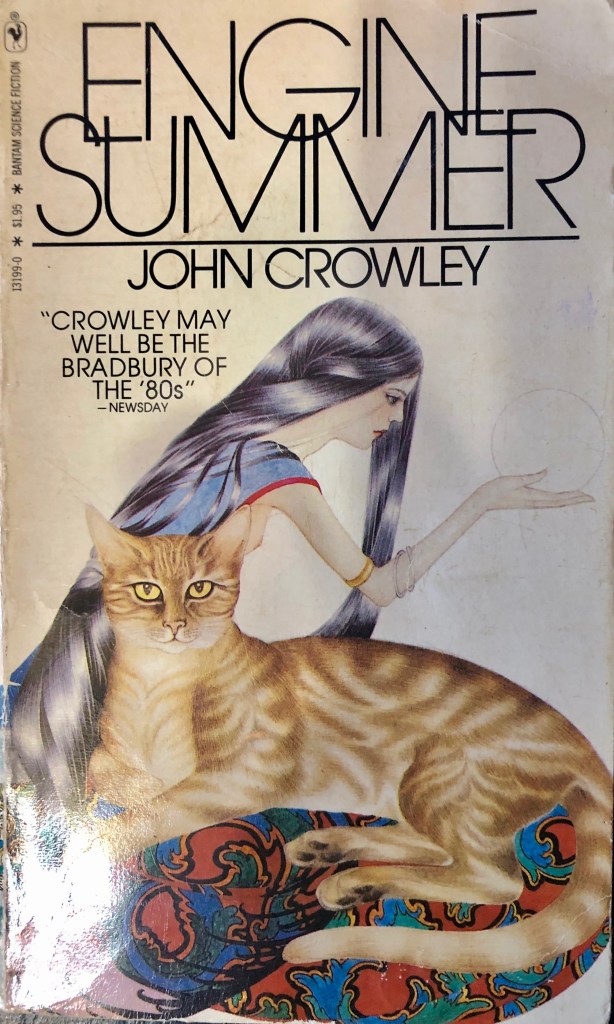
John Crowley, certainly one of my top ten favorite authors, has died. He was not a best-selling writer, though pretty well known among science fiction and fantasy fans. His most celebrated novels are “Little, Big,” and the four book “Aegypt” series. He also wrote film documentaries and taught creative writing at Yale. Of him the great critic, Harold Bloom said: “Crowley writes so magnificently that only a handful of living writers in English can equal him as a stylist, and most of them are poets…of novelists, only Philip Roth consistently writes on Crowley’s level.”
https://en.wikipedia.org/wiki/John_Crowley_(author)
Although my writing style is nothing like his (If only!), Crowley’s work has had a profound effect on my the way I approach writing a novel. The circumstances of my discovery of Crowley are almost as strange and uncanny as something from one of his stories.
In 1983 my my little family moved to Skagway Alaska, where I began building a log house. (See those images and comments elsewhere on this website.) My wife worked as a bartender and waitress, and I worked part time as a sort of carpenter/handyman. One day, while cleaning out a rental house I was doing some maintenance on, I found a box of cast away clothing, kitchen odds and ends, and paperback books left behind by one of the seasonal workers who came to Skagway every year to work in the tourist industry.
Normally I choose the books I want to read very deliberately, usually after reading reviews or getting suggestions from people with similar tastes in literature. I can’t recall ever before or since discovering a favorite author or book by chance alone. But something about the cover image and the intriguing title of “Engine Summer” made me pause and separate it from the rest of the things in that cardboard box. The name of the author also appealed to me. I had recently read two books by Aleister Crowley, and wondered if this John Crowley might be a relative. (In one of his blogs John Crowley assured his readers was not related, as far as he knew, and that Crowley is a fairly common English surname.)
I opened the book and read the writing on the inside of the cover. Immediately I wondered if this was a quote from the book, and if not, why was it there and who could have written it? (As you can see the name was scribbled out, as if the writer thought better of revealing his identity — see image below). I was hooked and began reading that same evening. Since then I have read the little novel dozens of times over the years. The book has some sort of strange hold on me, and each time I read it I discover something new. It is a melancholy tale, and profound on many levels.
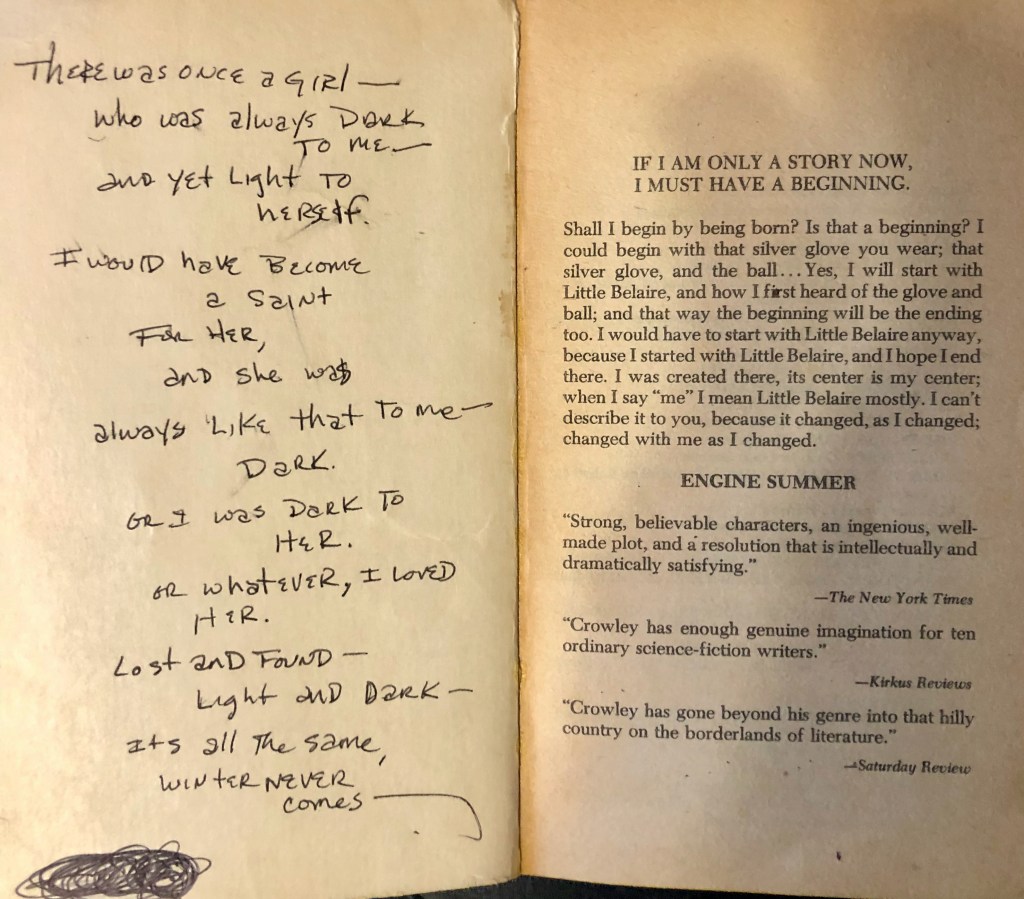
Since that summer of 1983 I’ve bought and given away many copies of Engine Summer, (including copies to all the actors and musicians in my musical, “Evermore”), but I’ve kept my treasured original Bantam 1980 edition. I’ve never found out who left that book behind, or wrote the words on the inside of the cover. I’ve also gone on to read most of Crowley’s other works. My favorites by him are “The Deep,” “Little, Big,” the “Aegypt” series, and several of his short stories.
In 2012 I got the idea of creating a musical based on Engine Summer. I extracted the basic love story, and my musical partner, Jim Nelson and I wrote songs for the play, which I entitled, “Evermore.” In 2013 the play was produced on two stages in Mt. Vernon and Bellingham, WA. (Images and commentary about Evermore are also elsewhere on this website.) I sent a link to a video of one of the performances to John Crowley. He remarked that he really enjoyed the music, but refrained from commenting on my bowdlerization of his novel.
Beyond the obvious inspiration for my play, Crowley has influenced me in other ways. He referred to “snakes-hands”— the parts of stories that don’t obviously advance the plot or character development—as some of the best parts of a tale. I agree, and to hell with critics or editors that say every word and sentence must serve the plot. I always include “snakes-hands” in my novels.
It is evident to me that Crowley knew the value of the role of the subconscious in good writing, and he admitted that some things in his novels seemed uncanny. I know what he is talking about. There are times when an idea will come to me seemingly “out of the blue,” or a character will simply not obey my desires. Sometimes, after days or weeks of no progress, I will wake knowing just exactly how a plot puzzle should be resolved. I never thought this way before reading Crowley’s works, particularly “Engine Summer,” “The Deep,” and “Little, Big.”
Certainly John Crowley was one of the great masters of the novel form, and deserves a much wider readership. But enough talk. If like me you love great writing, get a copy of one of Crowley’s novels or short story collections from your local bookstore or library. John Crowley has passed on, but fortunately for us most of his books are still in print and here for us to enjoy and marvel at. To paraphrase John from “Little, Big,” his fictional world gets bigger the further in you go.
“The world is older than it was. Even the weather isn’t as we remember it clearly once being; never lately does there come a summer day such as we remember, never clouds as white as that, never grass as odorous or shade as deep and full of promise as we remember they can be, as once upon a time they were.” (from Little, Big)

