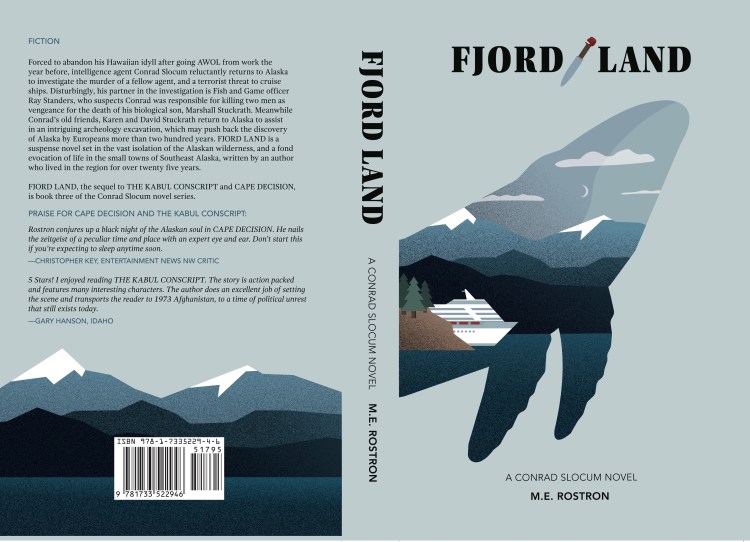
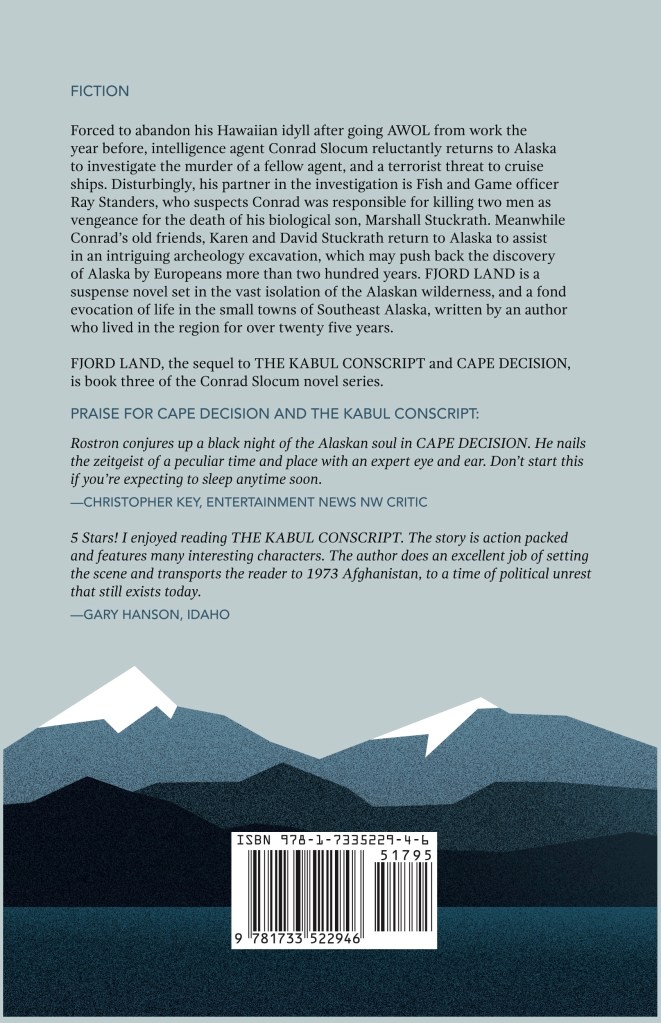
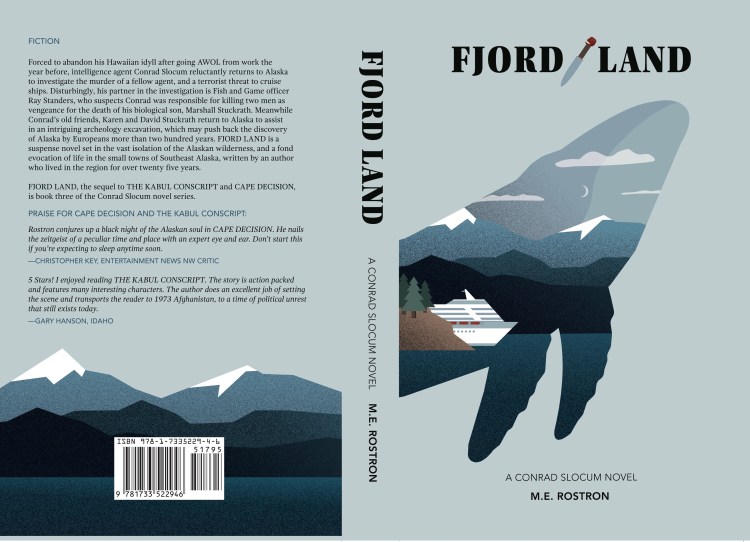
My fourth book and third novel, Fjord Land is now available from most any bookstore or the usual internet sites. As always I encourage you to patronize your local, independent bookstore, which can get almost any book you want even if they don’t stock it. My co-publisher, Village Books will mail the book to you anywhere in the USA for $2. Here is that link: https://www.villagebooks.com/book/9781733522946
Seaport Books in LaConner will host an author event and book signing for Fjord Land Wednesday, September 11, time TBA.
Your can read an excerpt from the first chapter in my previous blog post. Fjord Land takes place a year after Cape Decision in the summer of 2002, and is also set in SE Alaska. The Kabul Conscript is a prequel to both.
My fourth and latest book, “Fjord Land,” a sequel to “Cape Decision” and “The Kabul Conscript” will be on the shelves at Village Books in Bellingham next week (first week of June, 2024), and also available from any bookstore or online book source by special order. I plan to do a few regional author events and will post those locations and dates here and on my facebooks page.
I have a teaser for you, the fans of my two novels, The Kabul Conscript and Cape Decision.
Some readers have asked if I planned to publish another Conrad Slocum novel. I had hoped to write at least two more sequels before The Roving Fitzgeralds occupied me for most of 2021.
Since the Fitzgerald memoirs were published several writing projects have competed for my time and attention. I wrote a children’s book, which I hope to publish someday soon. Then came the science fiction short story, An Actuarial Tale which was published by the HamLit literary journal recently. At the same time more ideas continued to bubble away in that space between the unconscious and conscious where my story concepts seem to originate. One was the plot for a Cape Decision sequel.
I can now confirm that Fjord Land is in the pipeline and will be published sometime this May or June(2024)!
Although Cape Decision can be read without first reading the prequel, The Kabul Conscript, that isn’t the case with Fjord Land. For background you’ll want to read the first two in the series. The new story is set a year after Cape Decision, in 2002. Most of it takes place in Southeast Alaska. The novel features some of the same characters, and introduces more.
Pick up your copies of Cape Decision and The Kabul Conscript, and any other books from your local bookstore. Your local, independent bookstore can order these if they’re not in stock, and your money will circulate in your community.
Here’s an excerpt from the opening chapter. I hope it whets your appetite!
Skagway, Alaska
On a pleasant morning in early August, 2002 the immense cruise ship, Opal Princess disgorged a steady stream of passengers onto the Skagway dock. The ship, nine hundred fifty feet long, with a beam of over one hundred feet, and housing over four thousand passengers and crew—more than twice the swollen summer population of the tourist town itself—was visible from anywhere in town. It towered over the the well preserved gold rush community, whose tallest building, the Golden North Hotel, was a quarter the height of the vessel’s two hundred foot tall gleaming white superstructure.
Some summer days during the four month tourist season, Skagway, located at the far northern end of Southeast Alaska’s northern most fjord, entertained as many as four of the “Love Boats.” Two of the massive vessels could just barely fit end to end at the dock that ran along the steep cliffs on the southeast side of town. One or two more could be shoehorned into the small harbor at the White Pass Railroad pier in front of the town, further to the west.
Sandwiched between the giant floating cities, adding yet more traffic in bodies and automobiles to the mix, were the Alaska Marine Highway facilities; the ferry system that connected the major communities of Southeast Alaska. Although there was plenty of depth to accommodate the thirty foot draft of the largest vessels, the huge tidal fluctuations—fifteen feet and more, presented some challenges to berthing the massive ships. Additionally, the brisk winds that often funneled down Lynn Canal, the long narrow fjord that terminated at Skagway, sometimes prevented the ships from docking. On those occasions they were forced to turn back and substitute a stop at Haines, some fifteen miles further south, or retreat all the way back to Juneau, to the disappointment of both the passengers and the owners of the dozens of gift shops lining Skagway’s main thoroughfare, Broadway Street.
On this day the winds were calm, and the captain and crew, aided by the local tugboat had experi- enced no difficulties in maneuvering or docking. Most of the passengers were headed to the train station to board for the scenic trip up the famed White Pass, one of the two mountain passes leading to the Yukon and the historic gold rush towns in the Canadian interior. Other tourists continued on to the picturesque restored downtown, to run the gauntlet of the gift shops lining the wooden boardwalks of the eight block long business district.
The Jenkins family; Jim and his wife, Denise; Jim’s sister, Tess; and their children; eight year old Jimmy Jr., and twelve year old Samantha, had previously purchased a tour package which included the train trip, and an afternoon helicopter excursion to the glacier fields in the mountains above Skagway. It was their first trip to Alaska, and first on a cruise ship. All, especially Jimmy Jr., were excited to explore the town.
“Let’s stay together now, Jimmy!” his father called as the exuberant boy ran ahead along the dock, threading his way through the other disembarking passengers.
“Ah dad—you guys are too slow! I want to see those pictures on the rocks,” he called, pointing at the spray painted words and images that decorated (or de- faced, some said) the sheer cliffs above the dock.
“Maybe we can on the way back. We don’t have time for that now—come on back now, Jimmy!” his mother insisted.
But the boy had been cooped up for too long on the tour ship, and continued on, ignoring the entreaties of his parents.
“Samantha—go get your brother and bring him back here! We’ve only got thirty minutes until the train leaves.” her aunt Tess ordered.
It was her opinion that her younger brother and his wife were much too lenient with their son.
The girl, more obedient than her unruly brother, darted off after the boy. She caught him just as he was attempting to climb over the dock railing.
“What are you doing, Jimmy? Why do you always have to cause trouble?”
“Ah dad—you guys are too slow! I just want to see those pictures on the rocks,” he called, pointing at the spray painted words and images that decorated (or defaced, some said) the sheer cliffs above the dock.
“Maybe we can on the way back. We don’t have time for that now—come on back, Jimmy!” his mother insisted.
But the boy had been cooped up for too long on the tour ship, and continued on, ignoring the commands of his parents.
“Samantha—go get your brother and bring him back here! We’ve only got thirty minutes until the train leaves!” her aunt Tess ordered. It was her opinion that her younger brother and his wife were much too lenient with their son.
The girl, more obedient than her unruly brother, darted off after the boy. She caught him just as he was attempting to climb over the dock railing.
“What are you doing, Jimmy? Why do you always have to cause trouble?”
“There’s something down there—I saw it, Sam! Let go of me!”
“You can’t go down there. The sign says keep off. Anyway, you’ll probably fall in and they’ll have to get the fire department and police to rescue you.”
Still, Samantha was intrigued.
“Look yourself,” her brother said, pointing to one of the gaps between the thick planks of the dock.
His sister got down on her knees and peered into the shadowy darkness of the understructure. She caught her breath. Her brother was right. Something, or rather someone, was half floating in the nest of beams below.
I had an enjoyable interview today with Mike Mayberry of Cochise County Travels, who has done over 80 podcasts related to Old West History. You can listen to the podcast at a variety of places, including spotify, apple, instagram, etc.
My science fiction short story, “An Actuarial Tale,” was recently published in the literary journal, HamLit. It and nine other stories and poems by Northwestern writers can be read at no charge at the site. I’m happy to have one of my works in this great regional publication!
The story is set far in the future, when, due to medical advancements, most people live to be 100, or longer. But that creates some problems.
I have no plans to publish a collection of short stories, so I’m especially happy the HamLit editors liked this one. Most of my short stories are experiments, and they sometimes lead to ideas I can use in the novels.


 Captain Mike's Log