
When I was in my thirties I wasn’t afraid to tackle anything. We acquired 3 1/2 acres above Nahku Bay, about halfway between Skagway and Dyea in Southeast Alaska, in 1983. The location was off the grid, and we had no money for a generator or a well. There were a lot of pine trees on the property. My pioneer ancestors had built log homes in Montana and Oregon, so I decided to continue the tradition. More importantly, it seemed to be the least expensive option.
About half way through falling and limbing the trees the old chainsaw my father-in-law gave us refused to run, so I went at the task with an ax. The pine trees weren’t very big, but it was still hard work. At first it took me most of a day to fall, limb, and debark a tree. After few days at it I could do a half dozen a day.
Ultimately I built the house alone with an ax, hammer, handsaw, brace and bit, shovel, pickax, wheelbarrow, and a few other hand tools. My father-in-law, who had encouraged us to move to Skagway in the first place, lent me his dilapidated 1955 Chevy pickup. I used it to haul ninety pound bags of cement, and sand and gravel, which I dug from the banks of the Skagway river. On the way to our property I stopped at a creek and filled plastic garbage containers with water. At the house site I mixed the ingredients in wheelbarrow with a shovel and hoe. I mixed several yards of concrete in this manner.
While I put in long days building my wife worked serving tourists at the Red Onion bar in Skagway. Though our daughter, Lesley was only three, she was perfectly content to spend most days with me. She made friends with the squirrels and birds, and entertained herself playing among the rocks and dirt with her toys and dolls. At lunch time we sat together and ate our peanut butter sandwiches, fruit, and cookies. We talked about the wild creatures that lived in the forest around us, and I often read to her from one of the children’s books we brought along.
Our property was perched about two hundred feet above the bay and had very little level land. Luckily one of the best building locations was close to the road. It had a million dollar view down Lynn Canal, one of the longest and deepest fjords in the world. From here we could see the ferry coming up the fjord on its way north from Haines and Juneau, and the giant cruise ships that brought thousands of tourists to Skagway each summer. The site seemed to funnel sound up from the the bay. We would often hear porpoises breathing below us.
I had decided to build a 20X20 foot two story cabin with a gambrel or “hip” roof, which would give us about 600 square feet of living space, after subtracting the unusable parts of the second floor. While in college I had spent part of one summer working as a carpenter’s helper building a new house, but that was the extent of my building experience. One of the local Skagway carpenters who worked for the national park had suggested the gambrel roof design as an economical way to get a second story without building a full second floor. That type of roof is common in barn construction.
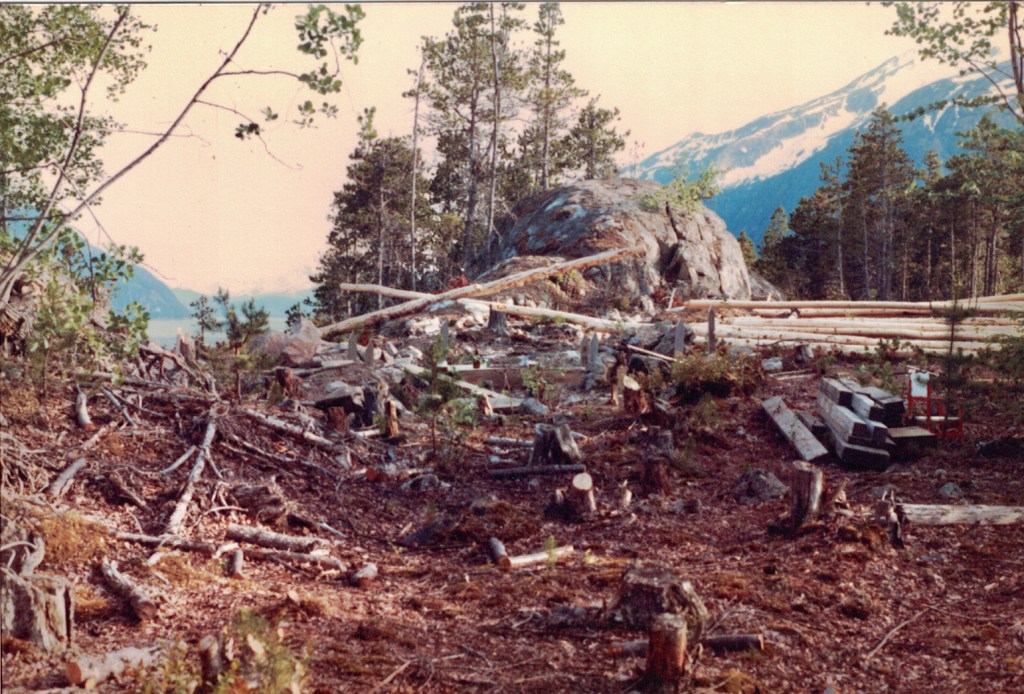
In this photo the site is mostly cleared. Quite a few logs are stacked in the background. These are lodgepole pines, which only reach the shore of Southeast Alaska at a couple of places, Skagway and a few miles south.

The first concrete is poured! I scrounged scrap wood wherever I could find it to use for forms.
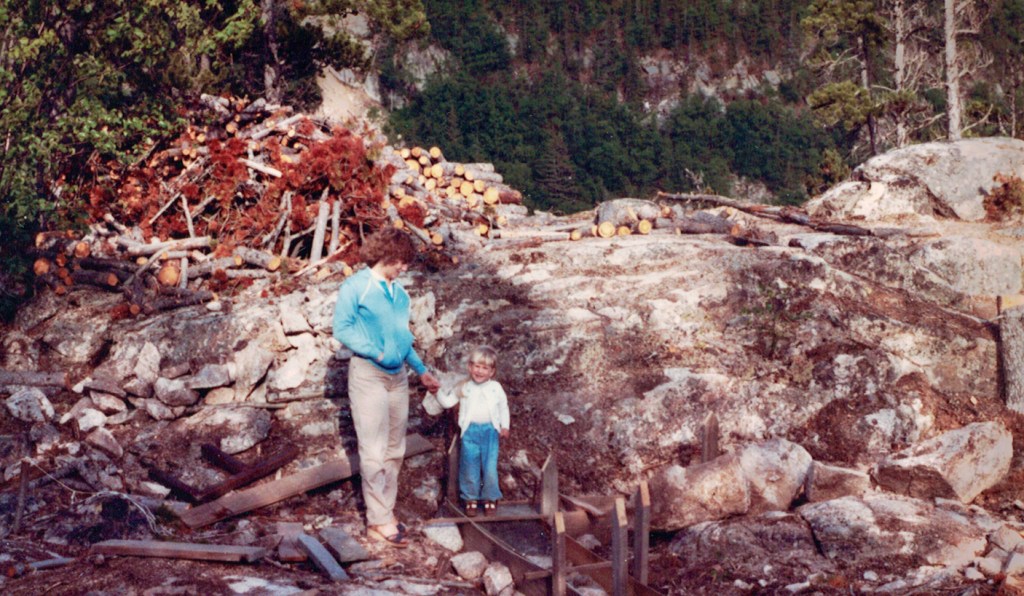
Celebration! The day before I had poured the first wheelbarrows of concrete into the footing forms. My daughter stands on the partially cured concrete, with my wife holding her hand. Behind them you can see I’ve already started piling up firewood rounds we would eventually use to heat our home. We needed at least five cords of wood to make it through the cold winters. At this early stage the chain saw was working, though I spent as much or more time working on it as falling and limbing trees!
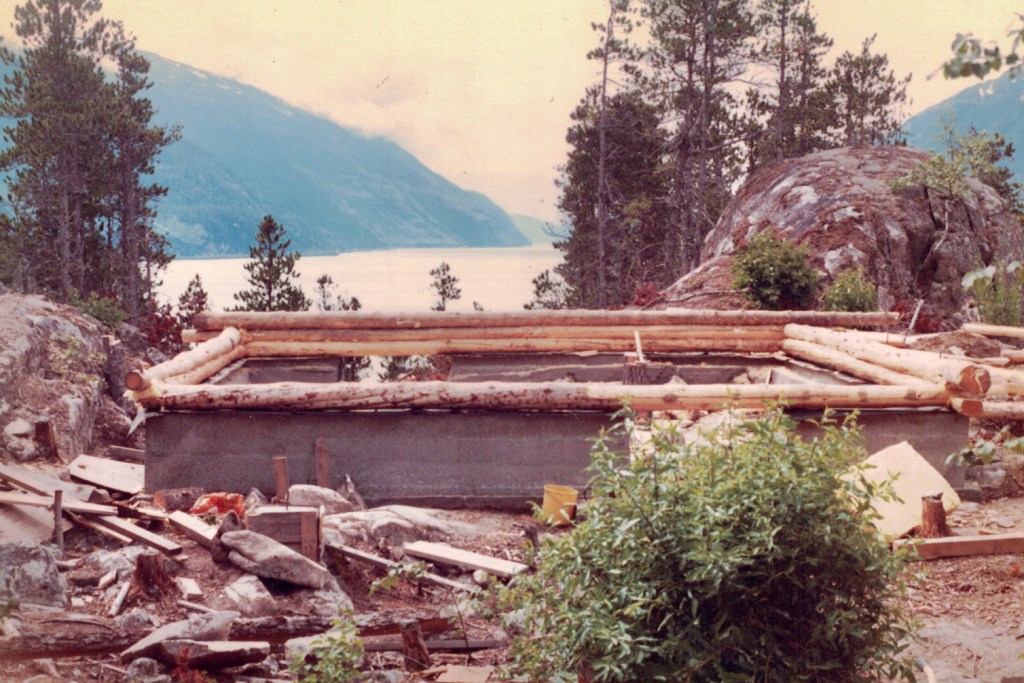
The foundation and first rows of logs. The view down the fjord was spectacular. I mixed the concrete for a footing and 2 foot high stem wall, a grueling and repetitious task that added several pounds of muscle to my previously slender frame. Dragging logs up to the foundation was equally arduous.
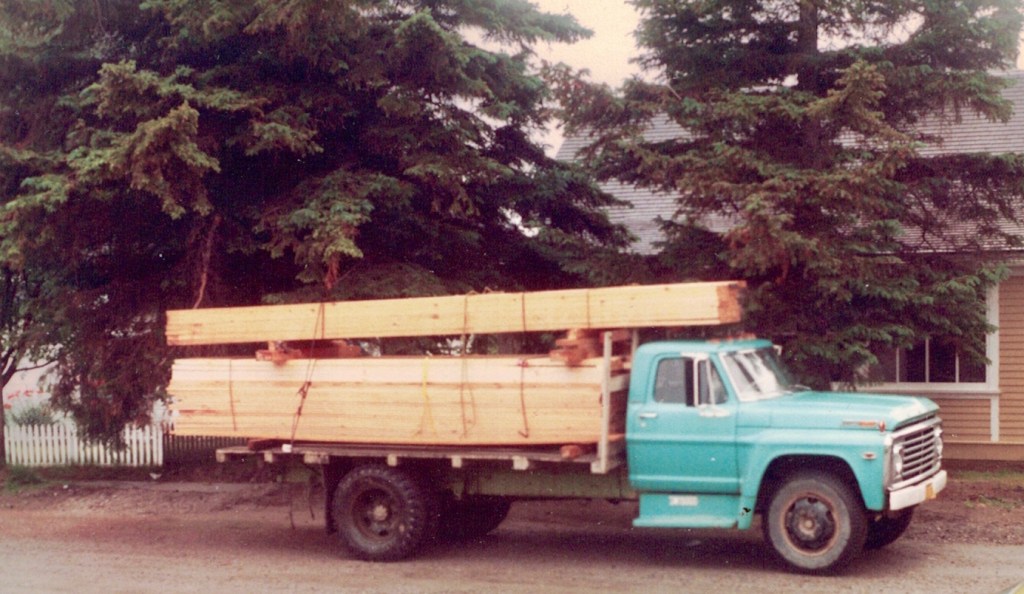
When we had accumulated a few dollars from my wife’s job and my occasional part-time work we ordered lumber for the floor joists, floor decking, and roof decking. The cheapest option was local spruce lumber milled by a man in nearby town of Haines. Buster Benson was missing most of the fingers of his hands from many years of operating his mill, but it didn’t seem to slow him down. The unplaned 2X12 joists were almost completely knot free, and measured a full 2 inches by 12 inches — not the 1 1/2X11 1/2 inches of commercial lumber. The decking was 1 inch thick. Here the loaded truck has come off the ferry from Haines (The only option from Haines to Skagway unless you drive 350 miles through Canada!) and is ready to head up Dyea road to our house site.
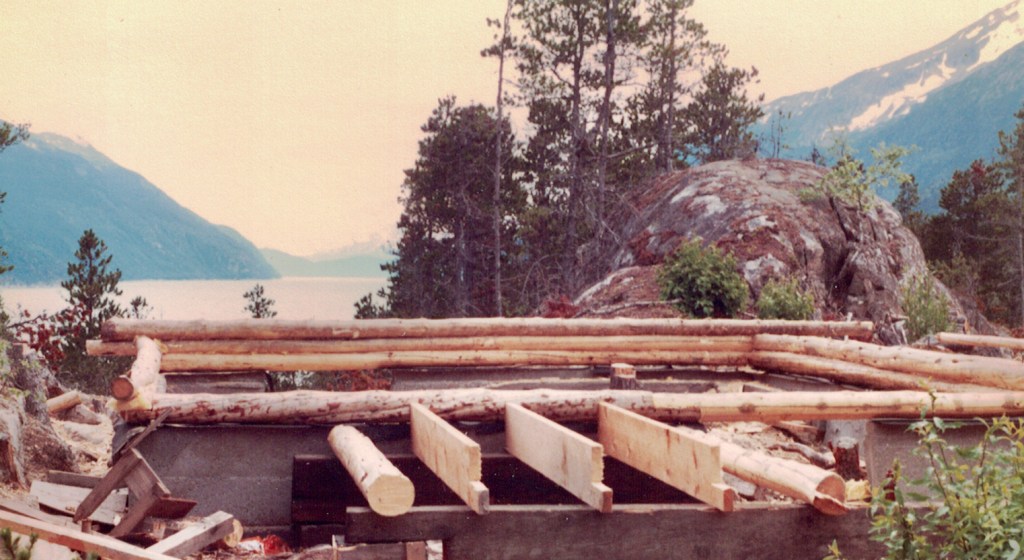
The entry way floor joists and a few logs are in place.
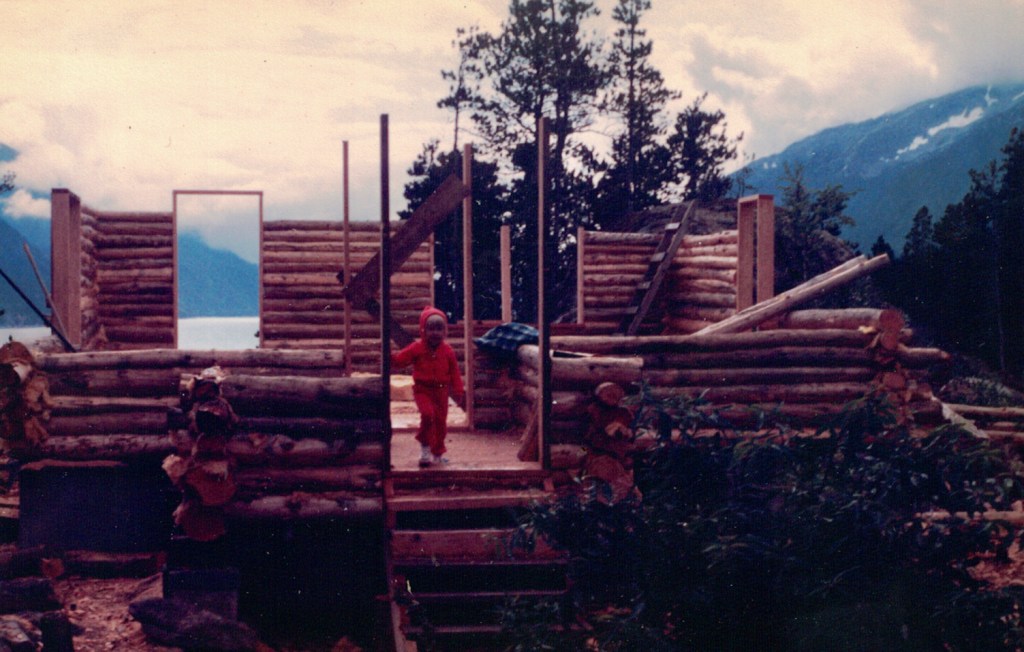
Here the windows and doors are framed and subfloor of 1X12 spruce is done. Using a hand drill and 1/2 inch bit (brace and bit) I drilled holes through the logs near the openings, and drove rebar down through the logs with a sledgehammer beside each opening. It was hard work, but I did not want to rely on gravity alone to keep the walls intact. Earthquakes are common in Alaska.

Looking south down the fjord, with Lesley standing in the framed door opening.


The horizontal log work is done, and the roof partially framed. I installed roof decking on the south side early to help as a wind break.
I had help on two occasions. First, when I was using the pickup and a chain to pull logs up to the site. The biggest and best logs were limbed and debarked down slope from the house site. The pickup was having a hard time pulling them up. The logs would get hung up in brush or on stumps. One day Mike “carefree” Caffree (sp?) came strolling by. He and other locals were curious about my project, and sometimes stopped by and chatted, or even offered a cold beer. Drinking beer and whisky while driving the dozen miles or so from Skagway to Dyea on the twisty and dangerous gravel road was a time-honored tradition in Skagway. I’m sure some were betting I’d never finish the house. No one ever offered a hand, but they were generous with their advice.
MIke was a notorious drunk with a checkered past, but a hard worker when sober, and he had a generous nature. He had become Ken Kesey’s drinking buddy the year before when the writer had spent time in Skagway as a movie consultant for Never Cry Wolf. Mike was a skilled heavy equipment operator and jack-of-all-trades who had worked all over Alaska. He saw the difficulty I was having and offered the use of a boom truck. He told me he could pull all of the roughly fifty logs up to the site in a couple of hours. I found that difficult to believe, but I could see it would take me a week or longer to get the logs on site at the rate I was going, and I was afraid I would destroy the pickup in the process. (The transmission was the two-speed “slush-o-matic” automatic that many Chevys had in the 1950s.)
I didn’t know, and he didn’t tell me that his driver’s license had been suspended due to numerous DUIs, and he had no permission to use the boom truck that belonged to a “friend” — a girlfriend who had recently broken up with him. I asked him how much money he wanted to do the job. He didn’t want money; just a case of beer and five gallons of gas for the truck. I found out later the liquor store would not sell him alcohol, so beer was the important part of the deal.
The next day Mike showed up with the boom truck. He ran down the draw unspooling the half inch cable as he went, wrapped it around two or three logs, then ran back to the truck. The winch on the vehicle was so powerful that it drug the logs rapidly up slope, ripping aside brush, knocking down saplings and smaller trees, and uprooting any stumps in the way. In about an hour he had all the logs on my building site.
His ex-girlfriend was furious when she found out he had “borrowed” her truck. A few weeks later, after she banned him from her property and threatened to get a restraining order, Mike burned down one of her buildings in a fit of drunken retaliation.
Mike left Skagway for good after that incident. A few years later I heard he was found frozen to death on a bulldozer up on the old mining road along Mineral Creek outside of Valdez. I never found out what he was doing up there in the middle of winter, but I’m sure alcohol was involved.

The view from the second floor looking west. Nahku Bay below, and just visible the gravel road along the side of the mountain. That part of the road experienced frequent slides and was often closed for repair. One year I was watching a crew working on the road when one of the workers was killed by falling rock.

Looking down the fjord through roof framing.
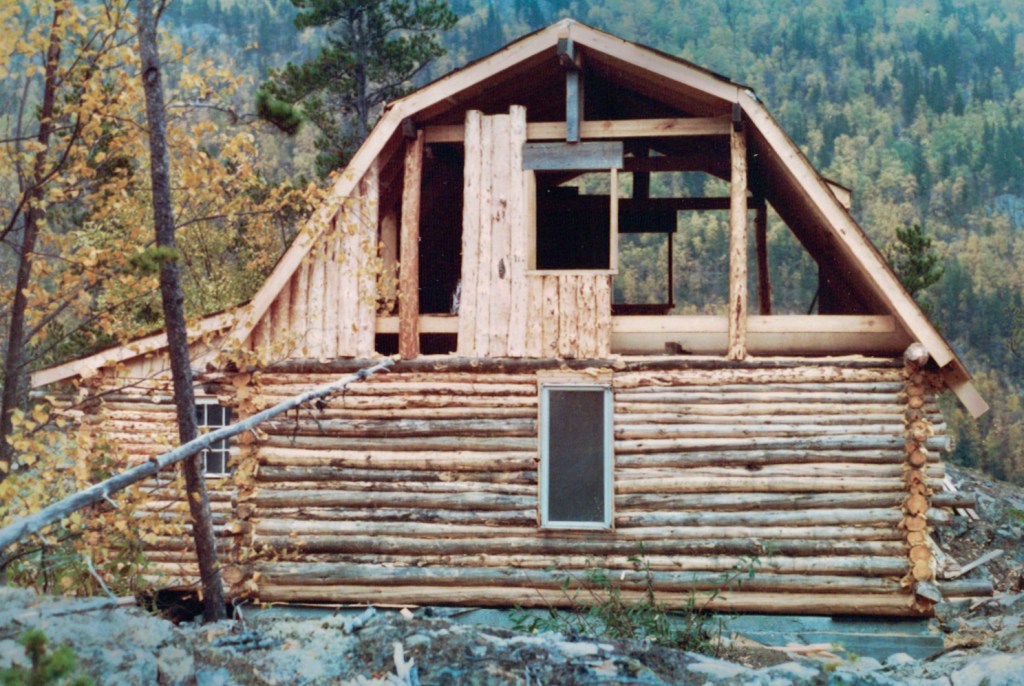
East side of the house. It was late summer, and I was rushing to try to get the building fully enclosed before winter.

I framed in dormers on the north and south sides upstairs to let in more light. The smaller cut off sections of the main house logs were used for the second story walls.

I salvaged old windows and a cast aside door, which were replaced later with when we could afford new ones.
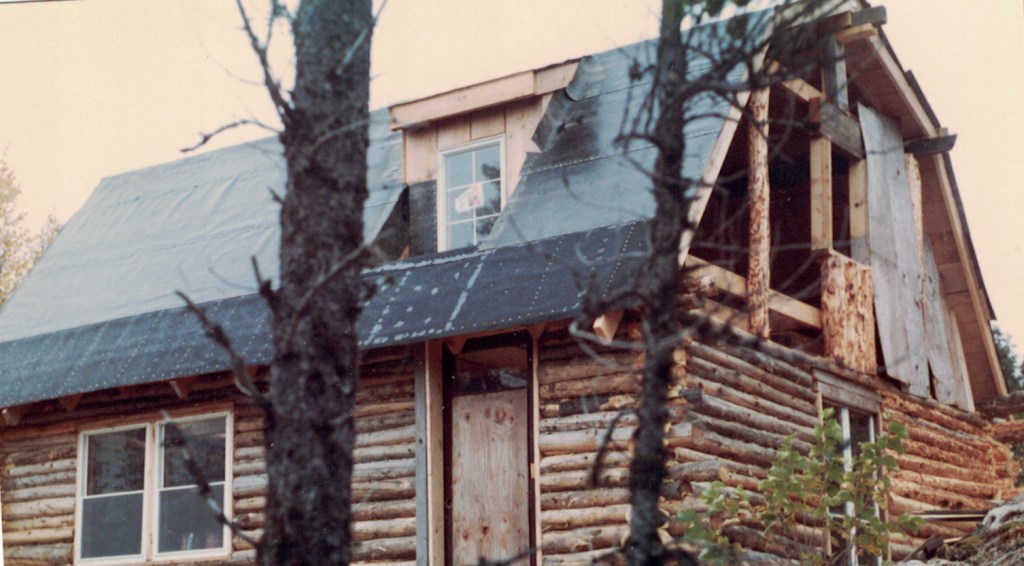
The first two years we made do with tar paper roofing. It kept us dry until we could afford shingles. It was quite a job tar papering that steep roof by myself!

Looking north. I constructed the heavy porch entrance door from left over log ends and 1X12s. By this point I had built an outhouse, but three year old Lesley preferred her potty chair.

Lesley posing against the south wall. One of the salvaged windows was cracked and taped. The next summer we were able to afford new double pane windows.

Completed dormer with nice new casement window!
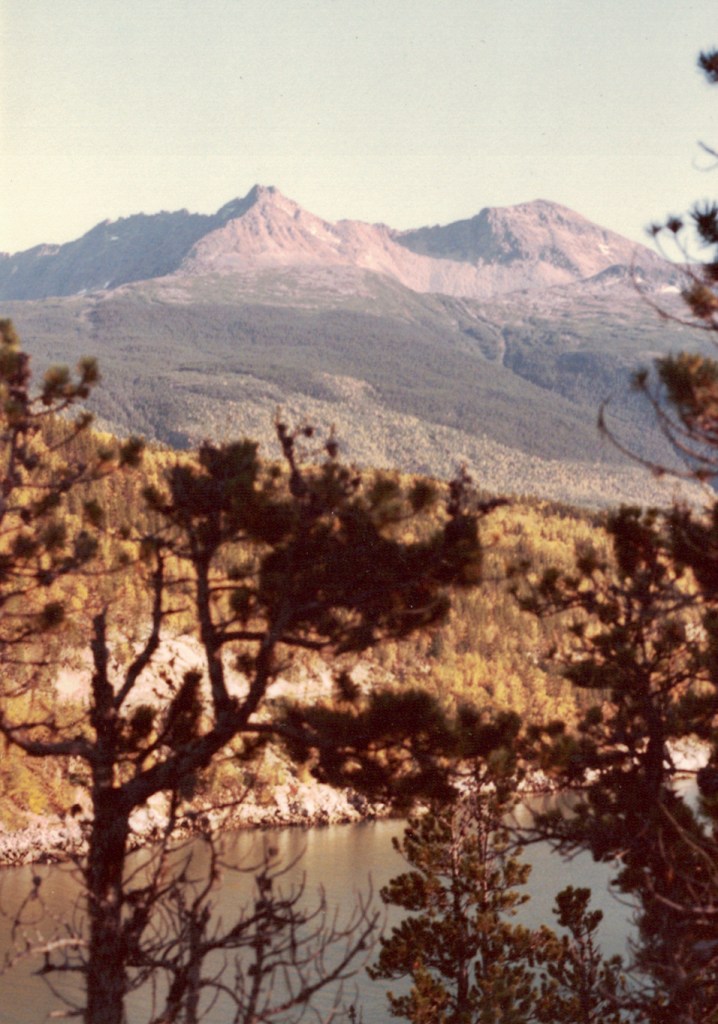
The view looking west from upstairs. The slide above the road is where the worker died while checking for loose rock. The mountains in the background rise above the town of Skagway.
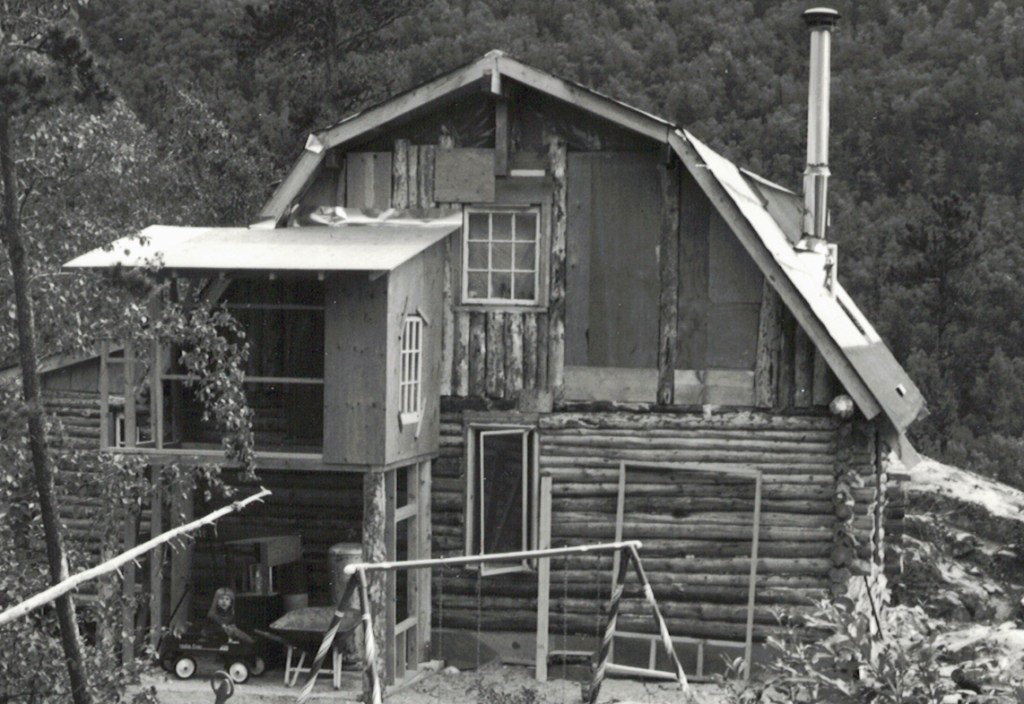
We had to haul all our water from the stream about 1/2 mile down the road. I used a small gas pump to pump it into 30 gallon garbage containers in the back of my van. In the winter I had to break ice on the creek. I built a shed against the house and insulated it well. The water tank was made out of plywood and sealed with epoxy. It gravity fed to a propane water heater below. The pilot from the water heater produced just enough heat to keep the water from freezing most of the time. But in extremely cold conditions the water would sometimes freeze in the plastic garbage cans before I could pump it into our storage tank. I’m not sure why I took this photo in black and white.
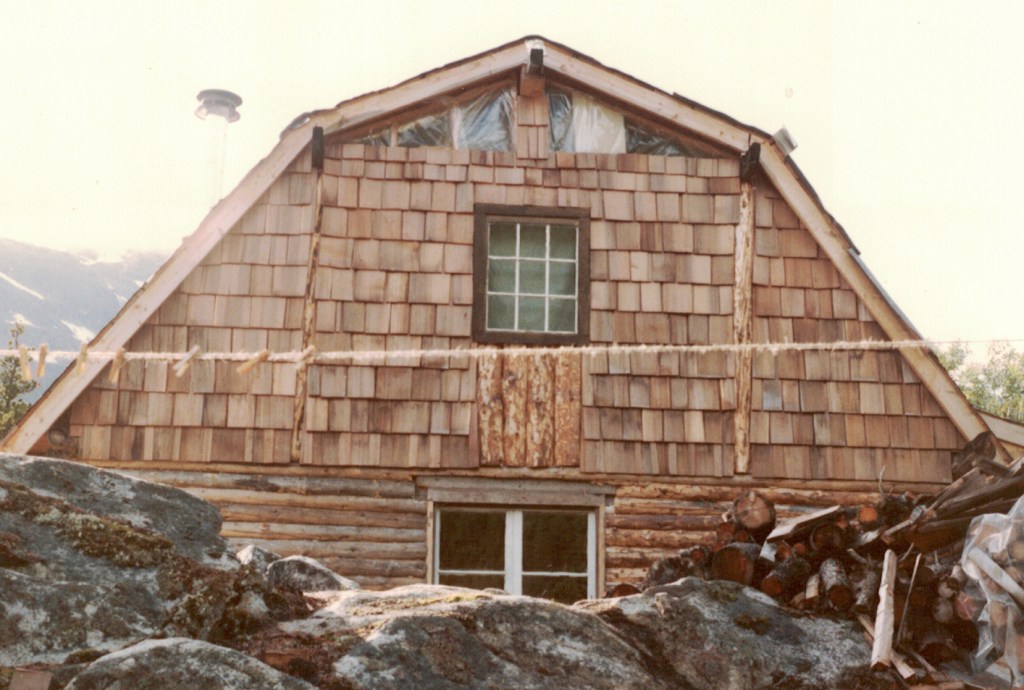
Before winter set in I managed to finish the gable ends with cedar shakes, and install some temporary salvaged windows. The next summer (1984) I replaced the plastic in the top triangular openings with glass, and installed new windows in the rest of the house; thanks partly to a grant program Alaska implemented, which helped Alaskans update windows and doors, and better weatherize their homes.

The following summer (1984) I installed a layer of plywood and vinyl flooring over the subfloor. We had spent the winter of 83/84 in Washington state, but starting in 1984 we lived in Alaska year round. We had a barrel stove and eventually backup propane heat. I installed propane lighting, a used propane range, and a propane hot water tank. We used 25 gallons of propane a month. Later we invested in a gas generator, and added electric outlets and lights. We limited our generator use mostly to evenings, or when I needed it to use the power tools I was accumulating.

The kitchen/dining area. Eventually we sheet rocked over the logs. That allowed us to add a layer of insulation to the walls, and made the house easier to keep clean.

I built Lesley a two story playhouse out of left over logs and scrap lumber.

In this photo I have added a deck to the front of the house, finished covering the water room with shakes, and shingled the house roof. I’m in the process of adding a window to the bathroom area. After one year of using the outhouse and going to town for showers we wanted something more convenient. I dug out an area downhill from the house and installed a makeshift septic tank. The down side of this was that we now went through much more water, and I spent much more time pumping and hauling water from the creek.
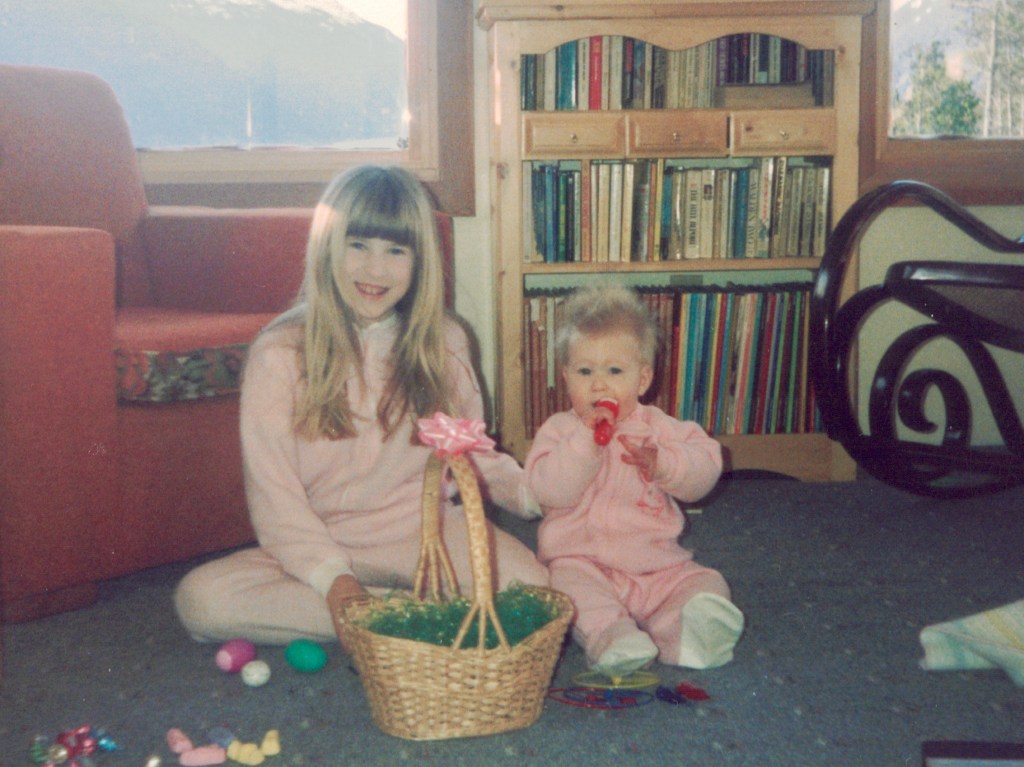
In 1989 our second daughter, Haley arrived. I had also added a 12X16 foot two story addition to the house. I had had my fill of chainsaw and log work, and had gained much building experience. The addition extended out over the draw, facing south, with decks on both levels. Here Lesley and Haley sit in the new living room, celebrating Haley’s first Easter, 1990. I’d also built a shop and taught myself cabinet making, which resulted in extra income in the winter. The book case made of pine board s was one of my first efforts.

I built a large shop at another somewhat level area just southeast of our house for my winter time cabinet making work, a place for my rock band to rehearse, and my new obsession — building an ocean capable sailboat.

Here I’m holding boat plans while my youngest daughter, Haley explores the shop. The drums and speaker in the foreground would be moved to the back part of the shop, where my rock band, “Ground Effect,” rehearsed.

This view, from 1992, shows the south end of the house addition, the 20X40 shop, and my sailboat in the process of being moved out of the shop.
With two children, and my wife now working full-time at the post office we regretfully decided to rent the house and move into Skagway. It was getting hard to keep up with work, school activities and the house chores. Electricity and phone service still had not been extended as far as our place (That happened a few years later.), and we still relied on creek water. Even so, I was able to realize my dream of building an ocean capable sailboat, which I launched in Haines in 1998. In the above photo the boat is being towed out of the shop and onto a low trailer for transport to town. It was quite an operation! You can see more photos of my boat project here on my website: https://mikerostron.com/once-i-built-a-boat/
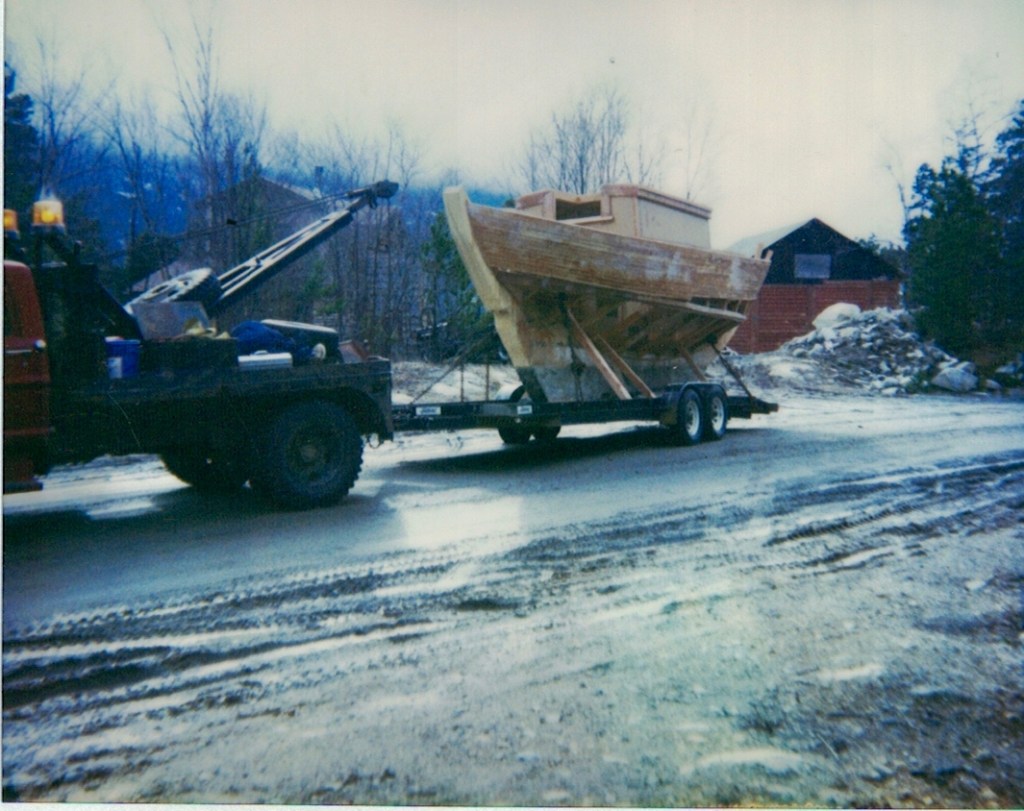
My partially constructed boat being towed down Dyea Road on its way to Skagway. In the background my shop is on the right, and house just visible to the left.
We eventually sold the house to a man who worked at the ferry terminal. He would go weeks without drinking, then buy a lot of vodka, and go home and drink steadily for days and nights, not going to work or coming out of the house until the liquor was gone. He was a heavy cigarette smoker as well. The combination proved lethal.
One night a ferry coming up the fjord from Juneau reported a fire on the hillside in Nahku Bay. By the time the fire department got there the house was beyond saving, and the firemen just managed to prevent a forest fire and save the shop.
The fire burned so intensely that nothing was left but the iron barrel stove, a few springs from the couch, and the concrete foundation. The man was identified by his teeth. The fire had reduced even his bones to ashes. An investigation concluded that he passed out on the couch, and a cigarette had started the fire.
I remember going to the site and taking a photo of the ruins, but I have not been able to find that photograph. The house was insured and another home was built at the site by the man’s sister. My old shop was converted into a rental house, though the wall nearest the house was singed by the fierce heat of the fire.
 Captain Mike's Log